7 Aside Football Rules: The Complete Beginner’s Guide to 7v7
7 aside football rules are a simplified version of the standard laws of the game: two teams of seven players (including one goalkeeper) play on a smaller pitch with smaller goals, shorter halves, no offside, and usually unlimited substitutions. It is one of the most popular forms of small-sided football in the world, played by youth teams, adult amateur leagues, and casual groups who want fast, fun, high-scoring games without the complexity of full 11-a-side.
This guide explains every important rule in simple language — and exactly where 7-a-side differs from the regular game.
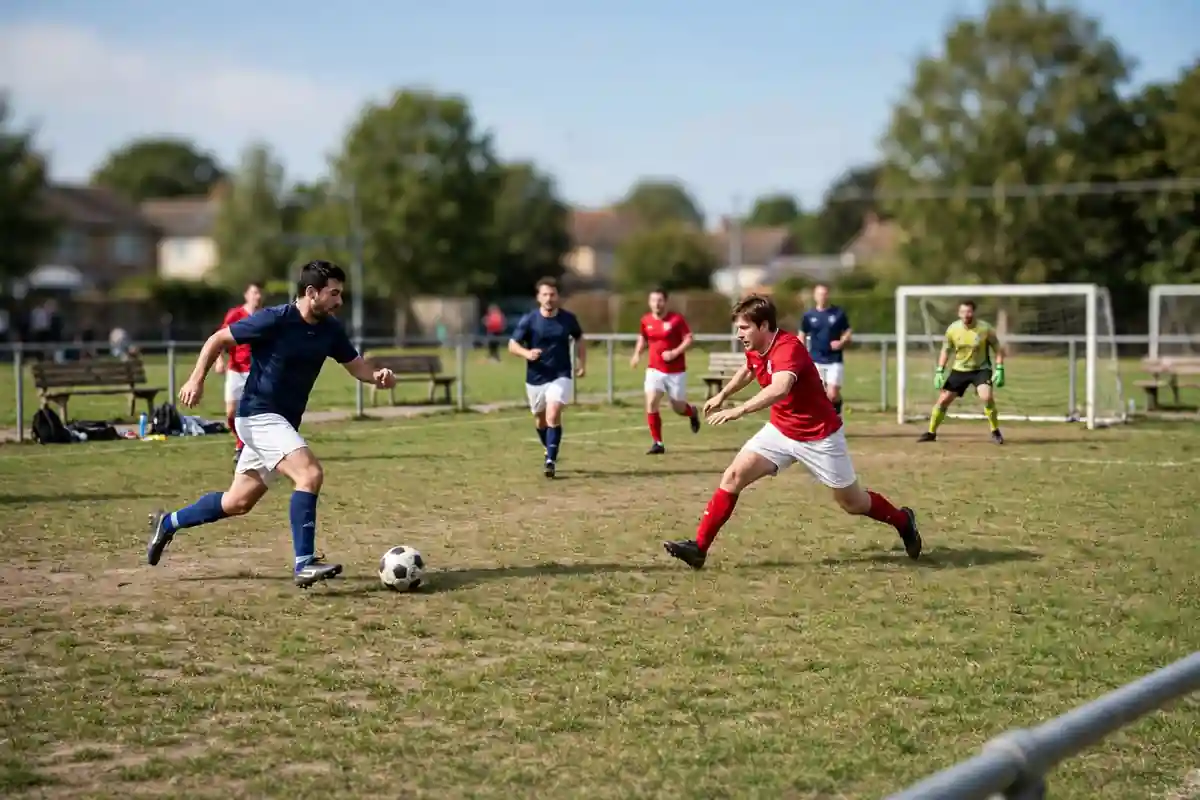
What Is 7-A-Side Football?
7-a-side football — often written as 7v7 or 7v7 soccer — is a small-sided version of association football. Instead of 22 players spread across a full-size pitch, you get 14 players on a compact field. The result is a quicker game with more touches of the ball, more goals, and more involvement for every player.
The format is hugely popular as a youth football format — kids develop faster with far more touches of the ball — but adults love it too: evening leagues and casual kickabouts need only 14 players and half a pitch to get a proper game going.
The guiding principle, used by bodies like England’s FA in their small-sided laws, is simple: the normal Laws of Association Football apply, with a few clear exceptions. Those exceptions are what this guide is all about.

7-A-Side Football Rules: The Full Breakdown
Team Size and Substitutions
- Each team fields 7 players, and one of them must be the goalkeeper.
- Squads usually include substitutes — many competitions allow up to 3 (a squad of 10).
- Most competitions require a minimum to start — commonly 5 players — or the team forfeits.
- Substitutions are usually unlimited: a player who comes off can come back on later.
- Subs normally happen during a break in play with the referee’s permission — your league sets the exact procedure.
7-A-Side Pitch Size and Goals
The pitch is much smaller than a full-size field, which is what makes the game so fast.
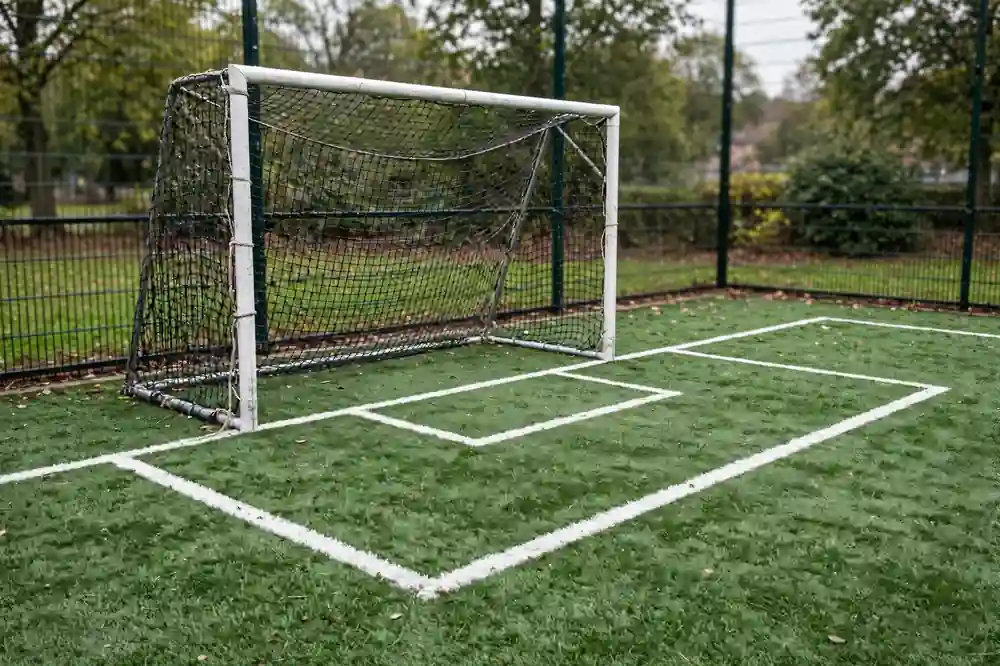
- Recommended pitch size: 50–60 metres long and 30–40 metres wide (about half the size of an 11-a-side pitch).
- Goals are smaller too: typically 3–5 metres wide and 1.20–2 metres high, compared to 7.32m × 2.44m in the full game.
- The penalty area is a compact semicircle — often a 6-metre radius from the centre of the goal — and the penalty mark sits about 6 metres out.
- Games are played on grass, artificial turf, or indoor courts. If you are curious how these measurements compare to the full game, see our guide to football field dimensions.
Match Duration
Forget 90 minutes. 7-a-side games are short and sharp:
- Most competitions play two halves of 20–30 minutes, with a short half-time break of around 5 minutes.
- Youth games tend toward the shorter end; adult evening leagues often play 25 or 30 minutes per half.
- The clock usually keeps running — arrive early, as halves may be shortened if a game starts late.
The Offside Rule in 7-A-Side
Here is the rule change players notice first: there is no offside in 7-a-side football.
That is right — the offside rule in 7-a-side simply does not apply. Attackers can stand wherever they like, including right next to the goalkeeper. This is deliberate: on a small pitch, enforcing offside would kill the flow and confuse young players. Instead, the game rewards quick passing and movement.
If you are new to the concept entirely, our beginner guide to football basic rules explains how offside works in the full 11-a-side game — useful context for understanding what 7v7 leaves out.
Restarts: Kick-Ins, Corners, and Goal Kicks
Restarts are where 7-a-side rules differ most visibly from the full game:
- Kick-ins instead of throw-ins: in most 7-a-side competitions, when the ball crosses the touchline it is kicked (not thrown) back into play from the sideline. A goal cannot be scored directly from a kick-in in most rule sets — check your league.
- Corners work the same as 11-a-side: taken from the corner arc, and a goal can be scored directly.
- Goal kicks are taken from inside the goal area, and a goal can usually be scored directly from one.
- Kick-off: the ball is placed on the halfway line and is in play once it is kicked and moves — it may go in any direction, just like the full game.
- Penalty kicks are taken from the penalty mark (around 6 metres out), with all other players outside the penalty area.
One caution: kick-ins, goal-kick rules, and scoring directly from restarts vary between competitions. Some youth leagues still use throw-ins. Always read your league’s rule sheet before matchday.
Fouls, Free Kicks, and Cards
The core of fair play is unchanged: kicking, tripping, pushing, handball, and dangerous play are all fouls, punished by free kicks, exactly as in 11-a-side. A few practical notes:
- Most free kicks in casual 7v7 are treated as direct — you can shoot straight at goal.
- Defenders must give the kicker space (competitions often require 5–6 metres).
- Yellow and red cards still exist, and many leagues add temporary dismissals (“sin bins”) — a couple of minutes off the pitch for dissent or repeated fouls.
- Serious misconduct — violent conduct, spitting, abusive language — is still a sending-off offence everywhere.
Goalkeeper Rules
The goalkeeper follows the same basic laws as in 11-a-side, with a couple of 7v7 twists:
- The keeper cannot pick up a deliberate back-pass from a teammate’s foot — the back-pass rule applies, and breaking it gives the opposition an indirect free kick.
- Some competitions require keepers to throw or roll the ball out instead of punting; others allow punting — check your rules.
- Keepers wear a different coloured shirt from both teams, as usual.
7v7 vs 11v11: Key Differences at a Glance
| Rule | 7-a-side | 11-a-side |
|---|---|---|
| Players per team | 7 (1 goalkeeper) | 11 (1 goalkeeper) |
| Pitch size | 50–60m × 30–40m | 90–120m × 45–90m |
| Goal size | 3–5m wide, 1.20–2m high | 7.32m × 2.44m |
| Match length | 2 × 20–30 min | 2 × 45 min |
| Offside | No offside | Offside applies |
| Substitutions | Usually unlimited | Limited (normally 5) |
| Touchline restart | Often kick-ins | Throw-ins |
| Ball size | Size 4 (youth) / 5 (adults) | Size 5 |
| Sin bins | Common in many leagues | Not standard |
If you want the full picture of player numbers across every format, read our article on how many players are in a football team.
Rules That Stay the Same
It is easy to focus on the differences, but most of football is identical in 7v7:
- A goal still counts only when the whole ball crosses the whole goal line between the posts.
- Handball, fouls, and misconduct follow the same definitions as the IFAB Laws of the Game.
- The referee’s authority is absolute — their decisions on the pitch are final.
For official wording, see the IFAB’s philosophy of the Laws and the free Laws of the Game documents.
Tips for Your First 7-A-Side Game
- Check the league rule sheet first. Kick-ins vs throw-ins, keeper distribution, and sin bins vary — five minutes of reading avoids matchday arguments.
- Bring the right ball. Youth games typically use a size 4; adult leagues often use size 5. Ask your organiser.
- Use your substitutions. Unlimited subs are a tactical tool — rotate tired players and keep the tempo high.
- Adapt to no offside. Defenders must track goal-hanging attackers; attackers should stretch the play wide.
- Wear shin guards. Required in most organised competitions and sensible everywhere else.
Real Match Case Study
Note: Famous 7-a-side matches are rarely recorded the way full international games are, so this is not a report on a real match. Instead, picture a typical Sunday-morning 7-a-side cup final to see how these rules play out in real life.
It is the second half of the final, and the score is 2–2 with ten minutes left. The pitch is small — only about 55 metres long — so the ball barely ever stops moving. One striker is standing just a few metres from the opposition goal, completely unmarked. In 11-a-side this would be offside and the play would be stopped. But there is no offside in 7-a-side football, so the winger simply passes to him and he scores. The defender complains to the referee, but the referee is right: offside does not apply, and the goal stands.
Two minutes later, the trailing team uses the substitution rules to their advantage. Because most 7-a-side competitions allow unlimited rolling substitutions, the coach takes off a tired midfielder and sends on a fresh player who had started the game on the bench. In 11-a-side, a substituted player usually cannot come back on — but here, rolling subs keep everyone involved and the tempo high. The fresh legs win a loose ball in midfield almost immediately.
Now the winning team’s captain makes the cleverest move of the day: he pulls his striker back to the edge of the penalty area to protect the narrow lead. With only six outfield players and a compact pitch, the team packs into a tight shape, and the final minutes become a desperate scramble. A shot from a quickly taken kick-in restart is cleared off the line in the last seconds, and the referee blows for full time. Final score: 3–2.
That fictional final shows the essence of 7v7: no offside creates goals from nothing, unlimited substitutions keep legs fresh, and the small pitch turns every game into end-to-end action. These are exactly the rules you will meet at your first 7-a-side match.
Frequently Asked Questions
Is there offside in 7-a-side football?
No — offside does not apply in 7-a-side. Attackers may stand anywhere on the pitch, including behind the last defender.
How long is a 7-a-side football match?
Two halves of 20–30 minutes with a short half-time break. Youth games run shorter; adult leagues usually play 25–30 minutes per half.
Can you score directly from a kick-in?
Usually not. A goal cannot be scored directly from a kick-in in most rule sets, though it can from a corner or a goal kick. Confirm with your league.
What size pitch is used for 7-a-side?
Recommended: 50–60m long and 30–40m wide, with goals 3–5m wide and 1.20–2m high. Exact dimensions vary by venue and competition.
How is 7-a-side different from 5-a-side?
Team size (7 vs 5 per side), a bigger pitch, and slightly longer games. Both formats skip offside and allow generous substitutions — see our 5-a-side football rules guide for the smaller format.
Conclusion
7-a-side keeps everything people love about football — goals, skill, teamwork — and strips away the complexity. The key takeaways:
- 7 players per team (one goalkeeper), smaller pitch and goals, 20–30 minute halves.
- No offside, unlimited subs in most leagues, and kick-ins often replacing throw-ins.
- Exact rules vary by competition — always check your league’s rule sheet.
- Everything else — fouls, cards, handball, the referee’s authority — follows the standard laws.
Now grab a ball, find six friends, and enjoy the fastest-growing way to play the game. And if you want to understand the people behind this guide, visit our about us page.
