Football Match Duration Rules: How Long Does a Match Really Last?
A football match lasts 90 minutes of regulation time: two 45-minute halves with a half-time break of up to 15 minutes in between. That is the direct answer. But anyone who has watched a full game knows the final whistle rarely blows at exactly 90:00. The referee adds stoppage time at the end of each half to make up for delays like injuries, substitutions, and time-wasting — so a typical match runs 95 to 105 minutes of playing time and close to two hours in real time from kickoff to the final whistle.
These timing rules come from Law 7 (The Duration of the Match) in the IFAB Laws of the Game, football’s official rulebook. New to the sport? Start with our football basic rules for beginners guide. Below, we explain every duration rule in simple language.
The 90-Minute Rule: What Law 7 Says
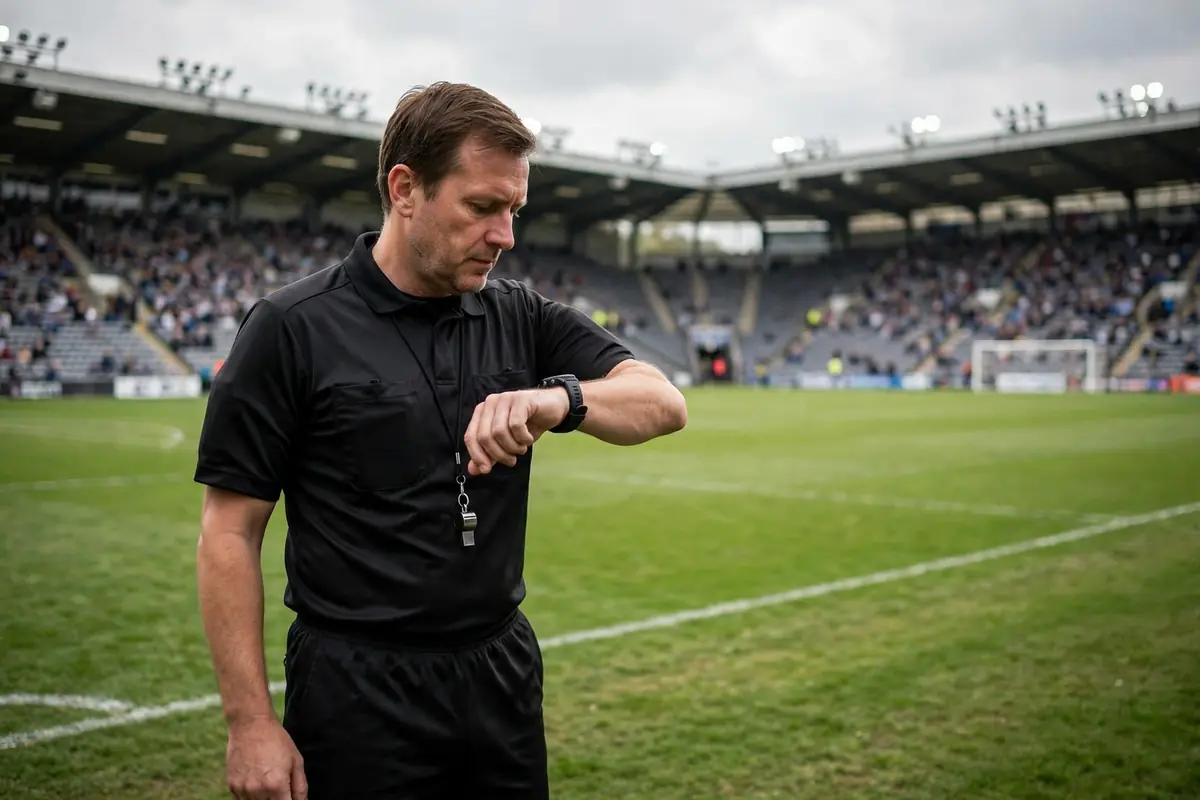
IFAB Law 7 states that a match lasts for two equal halves of 45 minutes. This is the default for virtually every professional competition in the world — domestic leagues, continental tournaments, and international matches all follow it. The 90-minute football rule dates back to 1897, when the laws first specified a standard 90-minute match duration.
A few key points from the law:
- The two halves must be equal in length. A team cannot play 40 minutes in the first half and 50 in the second.
- A match can only be shorter than 90 minutes if it was agreed before the match and the competition rules allow it. This is exactly how youth and amateur games legally play reduced times.
- The clock keeps running even when the ball is out of play. Unlike basketball or American football, the referee does not stop the watch for every throw-in or free kick. Lost time is added back later as stoppage time instead.
You can read the official wording in IFAB’s Laws of the Game.
Half-Time: The 15-Minute Break
The half-time duration in football is capped by law: the interval must not exceed 15 minutes. In professional football it is almost always the full 15 minutes, but competitions are free to set a shorter break — common in youth and amateur games.
What is half-time actually for? Three things:
- Rest and recovery — players rehydrate and catch their breath after 45+ minutes of running.
- Tactical changes — coaches adjust formations, fix defensive mistakes, and plan substitutions.
- Medical checks — physios treat knocks and strains picked up in the first half.
One timing detail many fans miss: when a knockout match goes to extra time, there is only a short break between the end of normal time and extra time — not another 15-minute half-time. And there is no break at all between the two 15-minute periods of extra time; the teams simply swap ends and keep playing.
Stoppage Time: Why the Clock Goes Past 90 Minutes
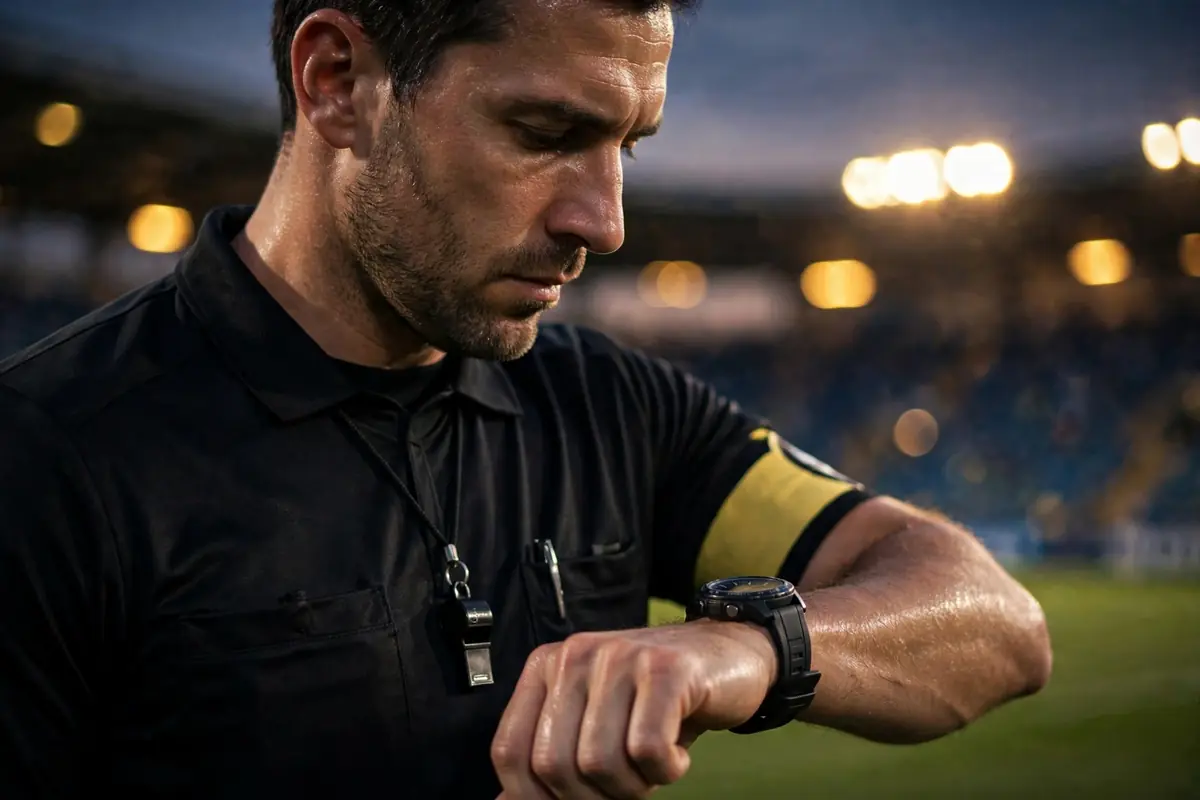
Stoppage time (also called added time or injury time — all three terms mean the same thing) is the extra time added at the end of each half to compensate for time lost during play. The stoppage time rules are straightforward: the referee alone decides how much time was lost, and the decision cannot be appealed.
The referee adds time for:
- Substitutions
- Injuries and medical treatment
- Deliberate time-wasting
- VAR checks and reviews
- Disciplinary actions (yellow and red cards)
- Goal celebrations
- Drinks breaks and cooling breaks in hot weather
- Any other significant delay to the restart of play
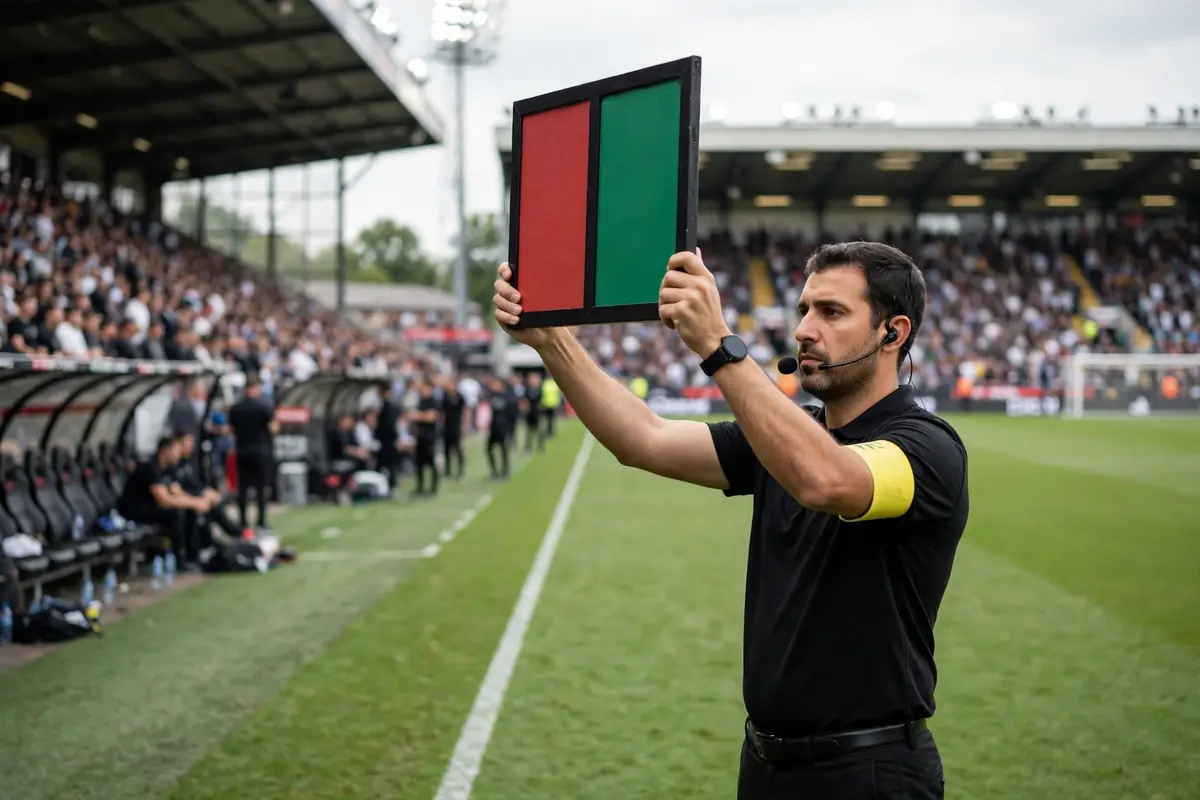
Near the end of each half, the fourth official holds up an electronic board showing the minimum amount of added time — for example, “+4” means at least four extra minutes will be played. Two things to remember about that number:
- It is a minimum. If further delays happen during stoppage time itself, the referee can add even more minutes on top.
- The referee cannot cut it short. Once four minutes are announced, at least four minutes must be played.
This is why you see scorelines recorded as 45+2 or 90+7: a goal in the “90+7th minute” simply means it was scored during the seventh minute of second-half stoppage time.
The Penalty Kick Exception: When a Half Must Be Extended
If a penalty kick is awarded just as time expires, the half is extended until the kick is completed — the referee cannot blow the whistle first.
This extension applies only to penalty kicks — not to free kicks, corners, or throw-ins. A referee may end the half before a last-second corner is taken; this famously happened at the 1978 World Cup, where a goal scored after the half-time whistle did not count.
What Happens If the Score Is Level?
A tied score does not change the 90-minute structure — what happens next depends on the format:
- League and group-stage matches usually end as a draw after 90 minutes plus stoppage time. Each team takes a point and the game is over.
- Knockout matches must produce a winner. Tied games go to extra time: two additional 15-minute periods, 30 minutes in total. If the score is still level after that, the winner is decided by a penalty shootout.
Full details are in our football extra time rules guide.
Youth and Small-Sided Match Durations
Not every football match is 90 minutes. Law 7 allows shorter durations when agreed in advance, which is exactly how youth football works. Shorter games protect young players’ developing bodies and keep matches fun rather than exhausting.
Typical youth formats (check your local league, as these vary):
| Age group | Typical duration |
|---|---|
| Under 10 | Two halves of 20 minutes |
| Under 12 | Two halves of 30 minutes |
| Under 14 | Two halves of 35 minutes |
| Under 16 | Two halves of 40 minutes |
| Under 18 | Two halves of 45 minutes (full length) |
Alternative formats have their own timing rules too:
- Futsal: two 20-minute halves with the clock stopped whenever the ball is out of play — the exact opposite of regular football.
- Beach soccer: three 12-minute periods.
- 5-a-side and 7-a-side: usually two short halves (often 10–25 minutes each), set by the tournament organizer.
How Long Should You Plan to Watch?
If you are planning your evening around a match, use these real-world estimates:
- Regular league match: about 2 hours (90 minutes + stoppage time + 15-minute half-time).
- Knockout match with extra time: about 2 hours 20 minutes.
- Knockout match with extra time and penalties: about 2 hours 30 minutes to 2 hours 45 minutes.
So the famous “90-minute game” is really a two-hour event.
Real Match Case Study: 93:20 — When Stoppage Time Won the League

No moment explains stoppage time better than 13 May 2012, the final day of the Premier League season. Manchester City hosted Queens Park Rangers at the Etihad knowing only a win would guarantee their first league title in 44 years — and that Manchester United, playing at Sunderland, would take the trophy if City slipped.
City led 1–0 at half-time through Pablo Zabaleta, but the second half unravelled: Djibril Cissé equalised in the 48th minute, Joey Barton was sent off in the 55th, and Jamie Mackie headed QPR 2–1 ahead in the 66th. As the clock hit 90:00, City were losing the title.
Then came added time. The fourth official’s board had signalled a minimum of five extra minutes — and remember, that number is only a minimum. In the 92nd minute, Edin Džeko’s header made it 2–2. In the 94th minute — 93 minutes and 20 seconds on the clock — Sergio Agüero received Mario Balotelli’s pass, burst past a defender, and smashed the ball past Paddy Kenny. City won 3–2 and took the title on goal difference.
The famous “93:20” timestamp is stoppage-time law in action: the referee’s announced minutes are a floor, not a ceiling, and play continues until the referee decides the lost time has been compensated. Had the whistle gone at exactly 90:00, there would have been no title. Instead, football got its most iconic reminder that the clock belongs to the referee — not the scoreboard.
Frequently Asked Questions
How long is a football match in total?
Regulation time is 90 minutes. With stoppage time and a 15-minute half-time break, the real-world total is usually 1 hour 50 minutes to 2 hours.
Why is stoppage time added instead of stopping the clock?
Football is built around continuous flow. Instead of stopping the clock for every interruption, the referee tracks lost time and adds it back at the end of each half.
Is half-time always 15 minutes?
No. The law says half-time must not exceed 15 minutes, but competitions may set a shorter interval. Youth and amateur matches often use shorter breaks, and there is only a brief pause — not a full half-time — before extra time begins.
Can a football match be shorter than 90 minutes?
Yes, but only if a shorter duration was agreed before the match and the competition rules permit it. This is standard in youth football, where halves are reduced according to age group, and in small-sided formats like 5-a-side.
How long is extra time in football?
Extra time is 30 minutes total — two 15-minute periods with a short break between them. It is only used in knockout matches, and stoppage time can be added during it too.
Conclusion
Football’s match duration rules are simpler than they first appear: 90 minutes, two equal halves, up to 15 minutes at half-time, and stoppage time to cover delays. Everything else — extra time, penalty shootouts, and shorter youth games — builds on that foundation laid down by Law 7.
Once you know these rules, watching football gets more enjoyable: you’ll understand the fourth official’s board, the 90+6 on the clock, and why cup finals run long. For more plain-language guides, explore GameGuidelines or meet the team behind the site.
Written by the GameGuidelines Team — football rules explained in simple language for fans, players, coaches, and referees.
