Football Ball In and Out of Play Rules: IFAB Law 9 Fully Explained
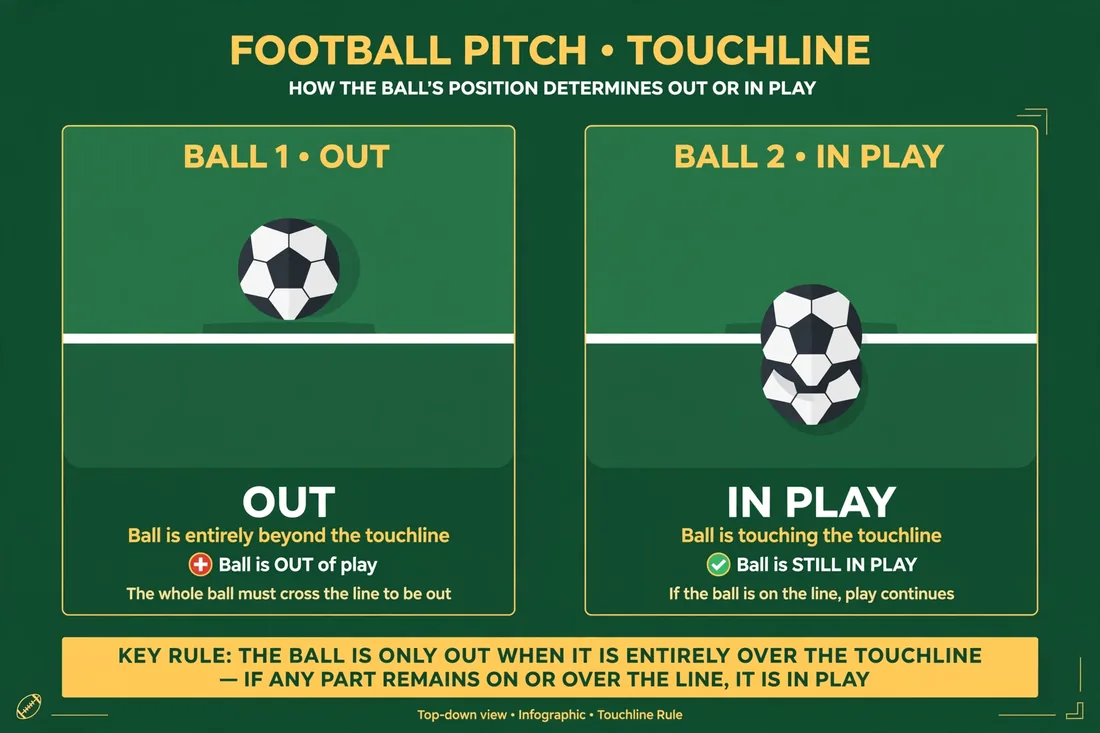
Every restart in football — every throw-in, goal kick, and corner — begins with a single judgment: is the ball still in play? Law 9 of the IFAB Laws of the Game answers that question, and its core principle is one of the most misunderstood in the sport: the ball is out only when the whole of the ball has wholly passed over the whole of the line. A ball sitting on the line is still in play. A ball that has crossed the line by 99% is still in play.
This guide explains exactly when the ball is in and out, what happens on rebounds off the woodwork and officials, the 2019 law change about referee deflections, and which restart follows every out-of-play situation. For more guides like this, visit the GameGuidelines homepage — we are building the web’s friendliest football rules library.

The Golden Principle: Wholly Over the Line
Law 9 states it plainly:
The ball is out of play when it has wholly passed over the goal line or touchline on the ground or in the air.
Three words do all the work here:
- Wholly — every millimetre of the ball must be beyond the line. If any part of the ball is still above the line, even the curved edge, the ball is in play.
- Goal line or touchline — the two long touchlines and the two goal lines. Crossing any of them ends play.
- On the ground or in the air — the line extends upward as an invisible vertical wall. A ball that flies over the touchline three metres in the air is out, even though it never touched the ground beyond the line.
The lines themselves belong to the field: a ball touching the line is in play, because it has not wholly passed over it. This is the single most common misconception in football — fans regularly scream “out!” at balls that are clearly still touching the line.
The Ball Stays In: Rebounds Off the Frame, Flags, and Officials
Law 9 then lists the situations where the ball remains in play:
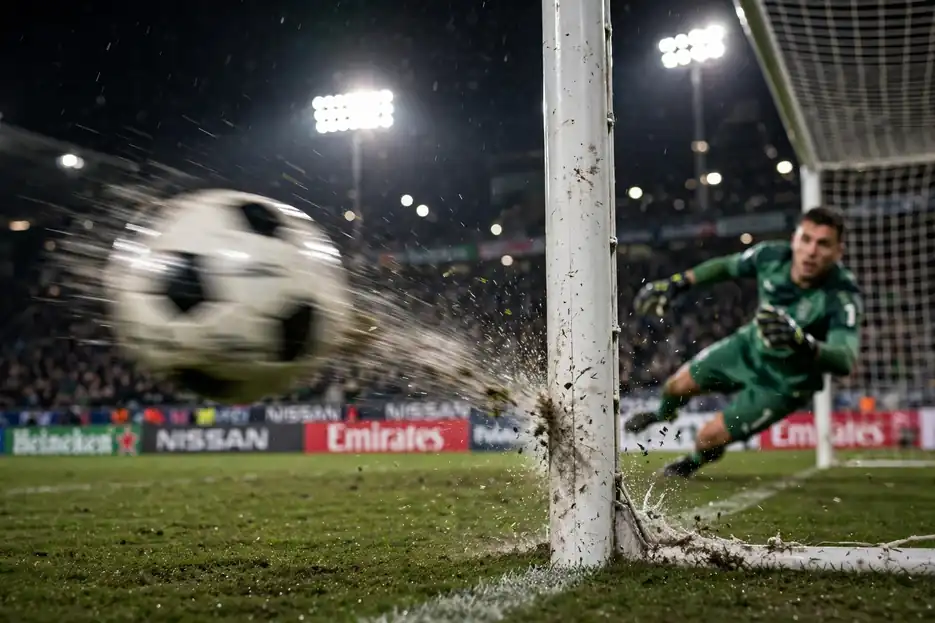
- It rebounds off a goalpost, crossbar, or goal frame back onto the field.
- It rebounds off a corner flagpost back onto the field.
- It rebounds off the referee or an assistant referee and stays on the field (with one important exception — see below).
The logic is consistent: none of these objects are “outside” the field of play for this purpose. A shot that smacks the crossbar and bounces back to an attacker is live — the attacker can score from the rebound, and regularly does. A ball that strikes the corner flag and spins back into play is live too, which is why you occasionally see wingers deliberately use the flag area to keep the ball alive.
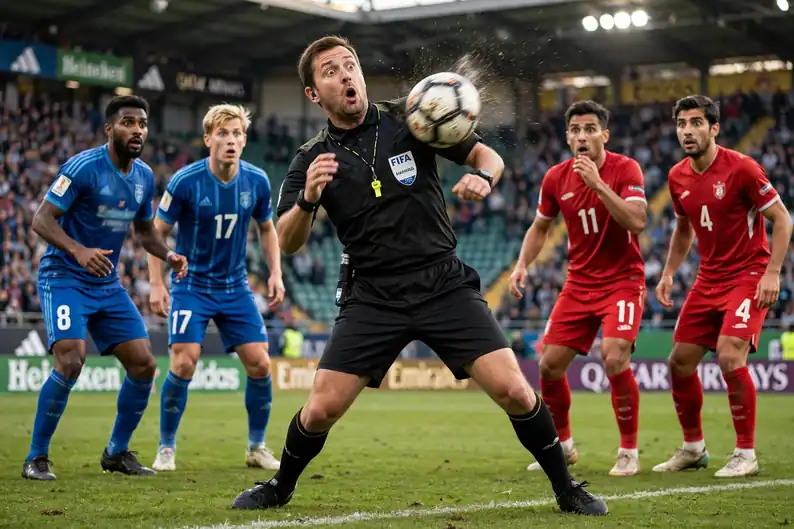
Match officials are treated the same way: the referee is, in the eyes of Law 9, part of the field. If a pass strikes the referee’s legs and falls to an opponent, play continues — the unlucky team has no grounds for complaint. At least, that was the complete picture until 2019.
The 2019 Exception: When the Ball Hits the Referee
In June 2019, IFAB amended Law 9 with a targeted exception. If the ball touches the referee (or another match official) and then:
- goes directly into the goal, or
- team possession changes, or
- a promising attack starts,
play is stopped and restarted with a dropped ball.
The change was made because it is, in IFAB’s words, “very unfair if a team gains an advantage or scores a goal because the ball has hit a match official, especially the referee.” Before 2019, a referee deflection that led directly to a goal simply counted — play on, goal stands. The amendment removed that lottery element while keeping the general principle (referee as part of the field) for harmless deflections. Our guide to football kickoff rules covers the other 2019-era change to restarts, the uncontested dropped ball.
The Exact Moment: When Does “Out” Happen?
The ball becomes out the instant the whole ball crosses the whole line — not when the referee blows the whistle, not when a player stops chasing it. The whistle merely confirms what has already happened. This matters in two practical ways:
- Everything after the moment is dead. If the ball wholly crosses the touchline and a player then smashes it into the net, there is no goal — play ended at the crossing. VAR routinely disallows goals for exactly this reason, sometimes rewinding 20 seconds or more to the moment the ball went out in the build-up.
- A ball that crosses and comes back is still out. A curling cross can cross the goal line in the air beyond the far post and then swerve back onto the pitch. It does not matter that it came back — it was out the moment it crossed, and the restart is a goal kick or corner depending on who touched it last.
Assistant referees are trained to watch the line, not the ball’s eventual destination, and to flag the instant the whole ball is over.
Which Restart Follows? The Complete Map
Once the ball is out, Law 9 hands over to the restart laws. The restart depends on which line was crossed and who touched the ball last:
| What happened | Restart | Awarded to |
|---|---|---|
| Ball wholly over a touchline | Throw-in | Opponents of the player who last touched it |
| Ball wholly over the goal line, last touched by an attacker, no goal | Goal kick | Defending team |
| Ball wholly over the goal line, last touched by a defender, no goal | Corner kick | Attacking team |
| Ball wholly over the goal line between the posts and under the bar, no prior offence | Goal | — |
| Ball touches referee then goes in / changes possession / starts attack | Dropped ball | Team that last touched it (or goalkeeper in the area) |
For the full mechanics of each restart, see our guides to throw-ins in football, goal kick rules, and corner kick rules.
Common Misconceptions
“The ball was over the line!” — Probably not wholly. Television angles mislead constantly; only the assistant referee’s line of sight, or goal-line technology, settles it. Fans routinely mistake a ball overlapping the line for a ball beyond it.
“It crossed the line in the air, so it’s still in.” — Wrong. The line extends vertically. A ball three metres above the touchline but beyond it is out.
“The ball hit the referee, so play must stop.” — Only since 2019, and only if a goal, possession change, or promising attack directly follows. Ordinary deflections off officials remain in play.
“Play stopped when the whistle blew.” — No: play stopped when the ball crossed the line. The whistle is confirmation, which is why goals scored after the ball went out never count, whistle or not.
What If? Tricky In-and-Out Scenarios
What if the ball crosses the touchline in the air and a player catches it before it lands? It is out — a throw-in. The line’s vertical plane was crossed, so the ball is out of play the moment it passes that plane, regardless of height.
What if the ball hits the corner flag and stays in? Play continues. The corner flag is specifically listed in Law 9: rebounds off it keep the ball in play.
What if the ball bursts mid-flight? The ball is no longer a proper ball, so play stops and restarts with a dropped ball where it burst (or according to Law 8). This is a defect, not an out-of-play situation.
What if a defender deliberately steps off the field to play an attacker onside, and the ball goes out? Leaving the field deliberately without permission is a separate issue, but the ball-out judgment is unchanged: wholly over the line means out, whoever is standing where.
What if the ball rebounds off the referee straight to a striker who scores? Since 2019, the goal cannot stand. Play is stopped the moment the promising attack develops from the deflection, and the game restarts with a dropped ball.
What if the whole ball crosses the goal line but the referee doesn’t see it? Then, human error aside, no goal is awarded and play continues — until VAR or goal-line technology intervenes. The law describes reality; officials do their best to match it.
What if a ball boy catches a ball that hasn’t fully crossed the line? Outside interference: the referee stops play and restarts with a dropped ball (or awards the appropriate restart if the interference prevented a goal). Ball boys are reminded to wait until the ball is clearly dead.
What if the ball is on the goal line during a goalmouth scramble? It is in play — all of it must cross. Defenders are entitled to hack it clear, and attackers are entitled to force it over. This is precisely the chaos goal-line technology was built to judge.
Real-Match Case Studies
The 19-second rewind — Aston Villa vs Brentford, Premier League, September 2026. Tammy Abraham thought he had marked his Aston Villa return with a late equaliser against Brentford, but a lengthy VAR check rewound the attack 19 seconds and found that Leon Bailey had carried the ball wholly over the touchline in the build-up before hooking it back into play. Referee Tim Robinson ruled the ball was “factually out of play,” the goal was disallowed, and Villa lost 1–0. Brentford later released footage citing Law 9.1 — “the ball is out of play when it has wholly passed over the goal line or touchline on the ground or in the air” — as pundits debated whether the broadcast angles conclusively showed daylight between ball and line. The incident is the purest modern illustration of Law 9: the “out” happened 19 seconds before anyone realised, and everything after it was dead.
The referee who scored — Dutch fourth division, May 2019. Weeks before IFAB’s 2019 law changes took effect, a match official in the Dutch fourth tier became the cautionary tale: the ball struck the referee and deflected into the goal — and under the old Law 9, the goal simply counted, because the referee was part of the field. The absurdity of a referee “scoring” helped drive the amendment that now stops play for a dropped ball whenever a deflection off an official leads directly to a goal, a change of possession, or a promising attack. It remains the go-to example of why Law 9 needed its exception: the old rule was logically consistent but produced outcomes nobody could defend.
Frequently Asked Questions
When exactly is the ball out of play in football?
When the whole of the ball has wholly passed over the whole of the goal line or touchline, on the ground or in the air. Partially over the line — even 99% — means the ball is still in play.
Does the ball have to touch the ground beyond the line to be out?
No. The line extends vertically, so a ball that crosses the plane of the touchline in mid-air is out of play.
What happens if the ball hits the referee?
Play normally continues — the referee is part of the field. But since 2019, if the deflection leads directly to a goal, a change of possession, or a promising attack, play stops for a dropped ball.
Is the ball out if it hits the post and comes back?
No. Rebounds off the goalpost, crossbar, or corner flag keep the ball in play, and attackers can score from them.
Who decides the restart after the ball goes out?
It depends on which line was crossed and who touched it last: touchline means a throw-in to the opponents of the last toucher; over the goal line means a goal kick (last touch by attacker) or corner (last touch by defender).
Can VAR disallow a goal if the ball went out earlier in the move?
Yes. VAR checks the attacking phase, and if the ball wholly crossed a line at any point in the build-up, the goal is disallowed — as Aston Villa discovered in September 2026 when a goal was chalked off for an out-of-play moment 19 seconds earlier.
What if the ball bursts during play?
Play stops because the ball is defective, not because it is out of play. The restart is a dropped ball where the ball burst.
Sources
- IFAB Laws of the Game — Law 9: The Ball In and Out of Play
- IFAB Laws of the Game — full document library
- Premier League — Law changes for 2019/20 explained
