Football Field Dimensions Rules: The Complete FIFA Guide
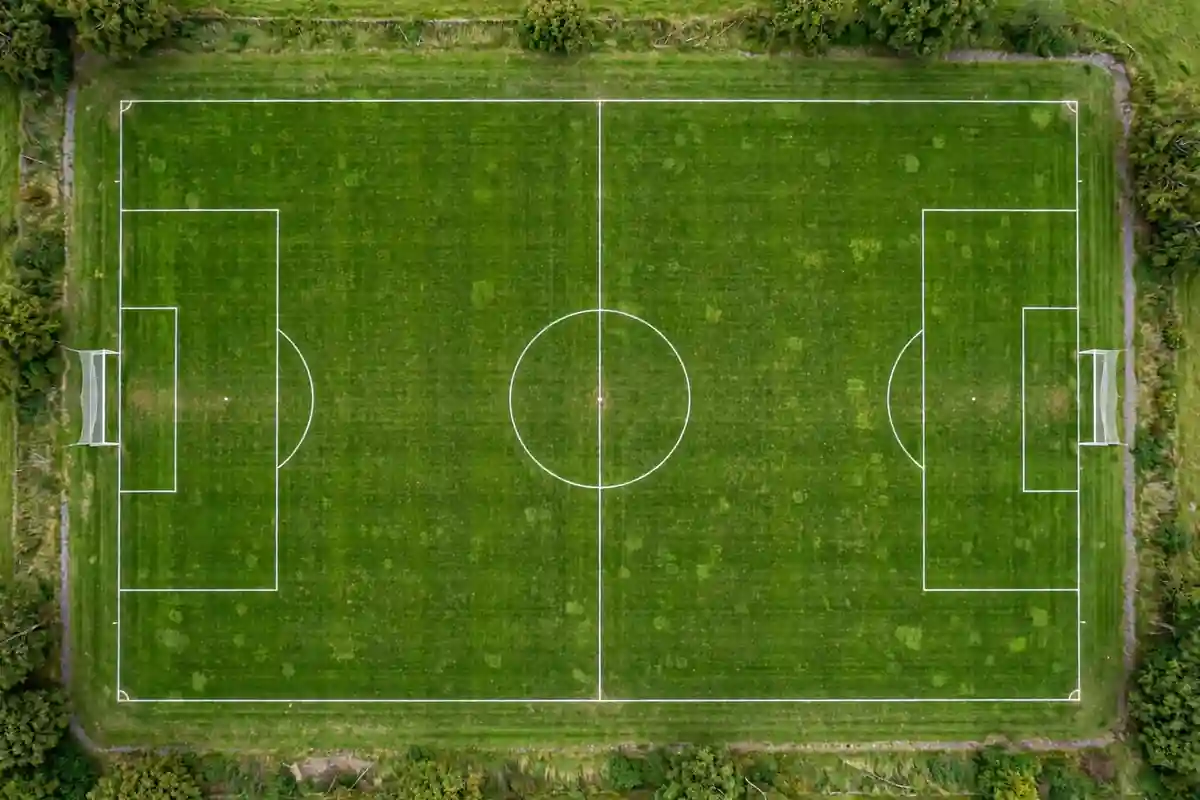
A football field must be between 100 and 130 yards long and 50 to 100 yards wide — but that is only the starting point. Every line, circle, and box on the pitch has an exact measurement set by IFAB Law 1 – The Field of Play, and all measurements are taken from the outside edge of the white lines.
In this guide, you will find the exact size of every marking: the penalty box, the goal area, the center circle, the penalty spot, the corner arcs, and the goals themselves — all following the official rules.
If you are new to the sport, start with our football basic rules for beginners guide first — this article builds on those foundations.
How Big Is a Football Field?
FIFA does not fix one single pitch size. Instead, the rules give a range, and clubs can choose any size inside it:
- Length (touchline): 100–130 yards (90–120 metres)
- Width (goal line): 50–100 yards (45–90 metres)
One strict rule: the touchline must always be longer than the goal line. A pitch can never be square.
For international matches, the range is tighter:
- Length: 110–120 yards (100–110 metres)
- Width: 70–80 yards (64–75 metres)
FIFA also publishes a recommended size of 105 × 68 metres (about 115 × 74 yards). Most top stadiums — Wembley, Old Trafford, the Etihad — use exactly this, which is why the biggest grounds look the same despite the allowed ranges.
Touchlines, Goal Lines, and Line Width
The two longer boundary lines are called touchlines. The two shorter boundary lines are called goal lines — note that the goal line runs the full width of the pitch from corner flag to corner flag, not just the part between the posts.
Three simple field markings rules apply to every line on the pitch:
- All lines must be the same width, no more than 12 cm (5 inches) wide.
- Lines belong to the areas they enclose. This matters more than it sounds: a player standing on the touchline is technically off the field, and a ball on the goal line has not fully crossed it.
- Measurements are taken from the outside edge of each line. If you ever mark out a pitch yourself, measure edge to edge — measuring from the inner edge will make everything slightly too small.

The Halfway Line and the Center Circle
The halfway line joins the midpoints of the two touchlines and splits the pitch into two equal halves. At its exact center sits the center mark, with a circle drawn around it at a radius of 10 yards (9.15 metres).
That 9.15-metre distance is one of the most repeated numbers in football. It is the minimum distance opponents must keep from the ball at every kick-off, and you will see the same number again at penalty kicks. The center circle exists simply to enforce that distance clearly and visibly.
The Penalty Area (18-Yard Box)
The penalty area is the most important zone on the pitch. Its exact penalty box dimensions are:
- 44 yards wide × 18 yards deep (40.3 × 16.5 metres)
It is measured from the inside of the goal line: two lines are drawn 18 yards into the field at right angles to the goal line, starting 18 yards to each side of the center of each goalpost, then joined by a line parallel to the goal line.
Two big rules depend on this box:
- The goalkeeper may handle the ball only inside the penalty area.
- Most fouls committed inside it by the defending team result in a penalty kick — which is why it is nicknamed the 18-yard box.
The Goal Area (6-Yard Box)
Inside the penalty area sits the smaller goal area, often called the 6-yard box. Its goal area size is:
- 20 yards wide × 6 yards deep (18.3 × 5.5 metres)
It is drawn the same way as the penalty area, but with 6-yard measurements from the inside of each goalpost and 6 yards into the field.
The goal area has one main job: goal kicks are taken from anywhere inside it. That is why goalkeepers place the ball wherever suits them within the box before kicking it back into play.
The Penalty Spot and the Arc (“The D”)
The penalty spot is a small mark 12 yards (11 metres) from the midpoint between the goalposts, measured from the goal line.
Around it, you will see the curved line known as “the D” — officially the penalty arc. It is part of a circle with a 10-yard (9.15-metre) radius centered on the penalty spot. Only the part of the circle outside the penalty area is marked, which is why it looks like a D rather than a full circle.
Its purpose is the same as the center circle’s: during a penalty kick, every player except the kicker and the goalkeeper must stay at least 9.15 metres from the spot — and outside both the penalty area and the arc.
Corner Arcs and Corner Flags
Each corner of the pitch has a corner arc with a radius of 1 yard (0.91 metres). This is a detail many guides get wrong by writing “1 metre” — the official measurement is one yard. The ball must be placed inside this arc (any part of the ball touching the line counts) for a corner kick.
A corner flag stands at each corner:
- Minimum height: 1.5 metres (5 feet)
- The top must not be pointed (a safety rule)
Referees may also place small optional marks 9.15 metres from each corner arc, at right angles to the touchline and goal line. These help defenders remember how far back they must stand at corner kicks — the same 9.15-metre distance again.
Goal Dimensions
Goals sit at the center of each goal line. Their exact size, measured between the inside edges of the posts:
- 8 yards wide (7.32 metres)
- 8 feet high (2.44 metres)
The posts and crossbar must be white, made of wood, metal, or another approved material, and must not be dangerous to players. Nets are common but are not strictly required by the laws — though every professional ground uses them.
All Football Pitch Measurements at a Glance
| Marking | Yards | Metres |
|---|---|---|
| Pitch length (touchline) | 100–130 (intl: 110–120) | 90–120 (intl: 100–110) |
| Pitch width (goal line) | 50–100 (intl: 70–80) | 45–90 (intl: 64–75) |
| FIFA recommended size | 115 × 74 | 105 × 68 |
| Line width (max) | 5 in | 12 cm |
| Center circle radius | 10 | 9.15 |
| Penalty area | 44 × 18 | 40.3 × 16.5 |
| Goal area | 20 × 6 | 18.3 × 5.5 |
| Penalty spot distance | 12 | 11 |
| Penalty arc radius | 10 | 9.15 |
| Corner arc radius | 1 | 0.91 |
| Corner flag height (min) | 5 ft | 1.5 m |
| Goal size (inner) | 8 yd × 8 ft | 7.32 × 2.44 m |
Common Mistakes About Field Dimensions
“All pitches are the same size.” They are not. The laws allow a wide range, and clubs genuinely use it — some teams even pick narrower pitches for a tactical home advantage. International matches just have stricter limits.
“The corner arc is 1 metre.” It is 1 yard (0.91 m). Close, but the laws speak in yards here.
“The 18-yard box is measured from the goalposts.” The 18 yards are measured from the inside of the goal line, and the width from the inside of each post — small but real distinctions when you mark a pitch.
“The goal line is only the part between the posts.” In the laws, the goal line is the entire line from corner flag to corner flag. The part between the posts has no special name.
Smaller formats scale everything down: 5-a-side football rules use much smaller pitches. And if you ever wondered why a team fields exactly eleven players on all that grass, our guide to how many players are in a football team explains the full setup, substitutes included.
Real Match Case Study
The most famous example of a club turning pitch dimensions into a weapon is Stoke City under manager Tony Pulis during their Premier League years from 2008 to 2013.
When Stoke earned promotion to the top flight for the 2008/09 season, Pulis ordered the groundstaff at the Britannia Stadium to make the pitch as narrow as Premier League regulations allowed. The laws of the game do not fix one single width — IFAB Law 1 lets clubs pick any width inside a set range — and Stoke chose the smallest end of that range. Their surface measured about 100 metres by 66 metres, the joint-smallest playing pitch in the league. The tight ground squeezed the space for visiting teams and fitted Stoke’s direct, physical style perfectly.
The real genius of the plan was Rory Delap. The midfielder had an extraordinary long throw: flat, fast, and powerful enough to fly from the touchline all the way into the six-yard box. With the touchlines pulled closer to the penalty area, Delap’s throws worked like extra corner kicks. Team-mate Liam Lawrence later said they were “almost better than corners” because of the chaos they caused. Stoke practised them constantly in training, and in that 2008/09 season roughly one in four of the club’s 38 Premier League goals came straight from a Delap throw-in. Big visiting sides — Arsenal, Everton, and Aston Villa among them — all conceded from them, and Stoke finished a comfortable 12th in their first top-flight campaign in decades.
The lesson is simple but important: the range written into Law 1 is not just a technical detail. Pitch dimensions are a real tactical choice. Stoke used the rules exactly as written and built a whole survival strategy around them — proof that the allowed sizes in the laws can shape actual matches, actual seasons, and actual results.
Frequently Asked Questions
How big is a football field in metres?
A full-size pitch is 90–120 metres long and 45–90 metres wide. For international matches, FIFA narrows this to 100–110 metres long and 64–75 metres wide, and recommends 105 × 68 metres.
What are the dimensions of the penalty box?
The penalty area is 44 yards (40.3 m) wide and 18 yards (16.5 m) deep, measured from the inside of the goal line. The goalkeeper can handle the ball inside it, and defensive fouls inside it usually mean a penalty kick.
How far is the penalty spot from the goal?
The penalty spot is 12 yards (11 metres) from the goal line, measured to the midpoint between the goalposts.
What is the 6-yard box used for?
The 6-yard box is the goal area. Its main purpose is goal kicks: the goalkeeper (or any player) may place the ball anywhere inside it before taking the kick. It measures 20 yards wide and 6 yards deep.
Are all football pitches the same size?
No. The laws allow a range of sizes, so club pitches differ — though most top stadiums follow FIFA’s recommended 105 × 68 metres. Only international matches must fit the stricter 100–110 × 64–75 metre range.
Conclusion
The key takeaways on football field dimensions rules:
- Pitches range from 100–130 yards long and 50–100 yards wide; internationals use a tighter range, and 105 × 68 m is FIFA’s recommended size.
- The penalty area is 44 × 18 yards, the goal area 20 × 6 yards, and the penalty spot sits 12 yards from goal.
- The magic number 9.15 metres (10 yards) appears everywhere: center circle, penalty arc, and corner-kick distance marks.
- Goals are 8 yards wide and 8 feet high, measured from the inside edges.
- All measurements come from the outside edge of the lines, and lines may be no wider than 12 cm.
For the full official wording, see the IFAB Laws of the Game documents. And if you want to know who keeps all these rules running the site, meet the team on our About Us page — or head back to the GameGuidelines homepage to keep learning the laws of the beautiful game.
