5 Aside Football Rules: The Complete Guide to 5v5
Five-a-side football is played with five players per team — four outfield players and one goalkeeper — on a small, often enclosed pitch with smaller goals and shorter halves. There is no offside rule, slide tackles are usually banned, and substitutions are unlimited, which makes the game fast, safe, and perfect for beginners.
If you are joining your first 5v5 league, playing with friends after work, or coaching a youth team, this guide covers every rule you need: pitch dimensions, players and substitutions, match duration, fouls, goalkeeper restrictions, and how restarts work. One important note up front: exact 5-a-side rules vary between leagues and venues, so always check your competition’s rulebook — what follows is the widely used standard based on the English FA’s small-sided laws.

What Is 5-a-Side Football?
5-a-side is a small-sided version of association football: five players per team on a compact court or pitch, usually indoors or on artificial turf. The smaller space means more touches, quicker decisions, and constant involvement — every player attacks and defends.
It is played casually in parks and sports halls worldwide, and competitively in organised leagues. Because the laws are adapted from the 11-a-side game, beginners sometimes get confused — the sections below clear that up. Completely new to football? Start with our football basic rules for beginners guide first.
The 5-a-Side Pitch: Size, Goals and Markings
5-a-Side Pitch Size
The English FA recommends the following dimensions for 5 and 6-a-side football:
- Length: 25m minimum, 50m maximum
- Width: 16m minimum, 35m maximum
- The touchline must always be longer than the goal line
- The pitch is divided by a halfway line, with a 3m-radius centre circle
Many commercial venues use pitches around 30–40m long and 20–30m wide. Some pitches are surrounded by barriers or boards that keep the ball in play; others use standard boundary lines like a normal football field.
Goals and Penalty Area
- Goal size: 3m to 5m wide (inside measurement), 1.20m to 2m high
- Penalty area: a semi-circle with a 6m radius drawn from the centre of each goal line
- Penalty mark: 6m from the midpoint between the goalposts
- Corner arcs: 25cm quarter-circles in each corner (where no barriers exist)
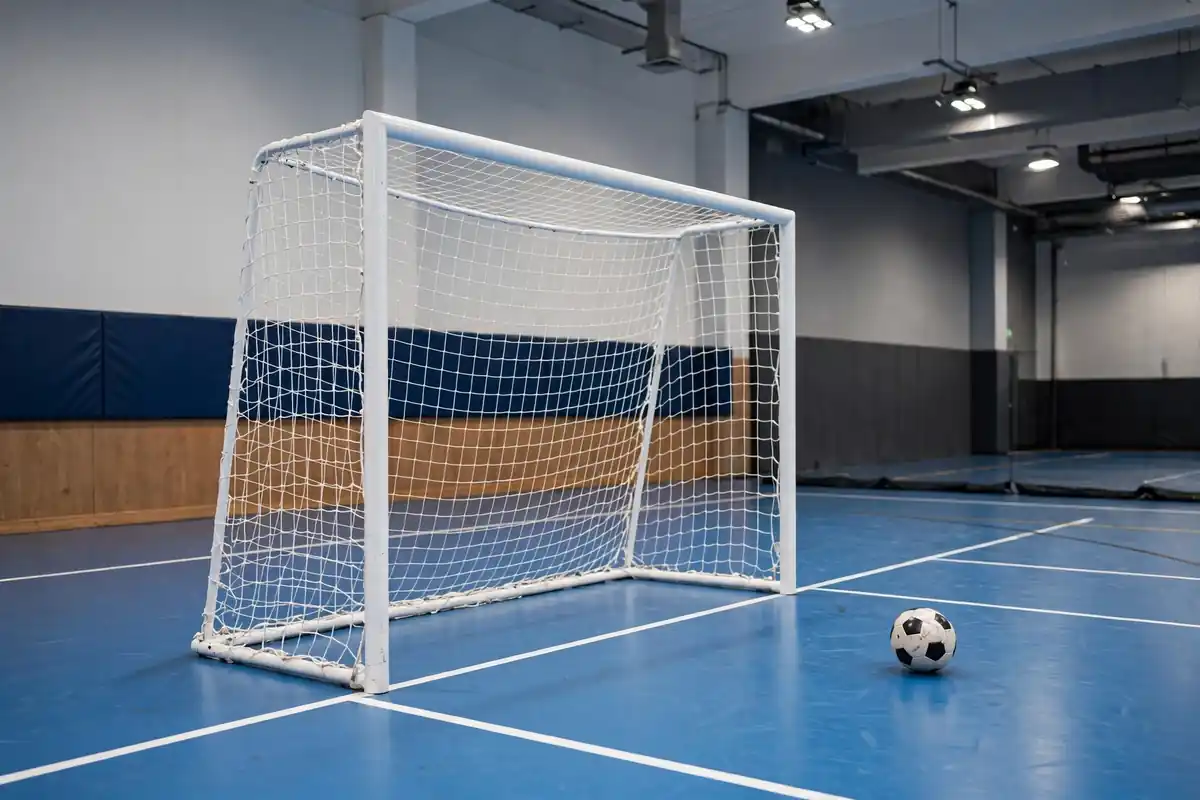
Only the Goalkeeper in the Area
In most 5-a-side formats, only the goalkeeper may touch the ball inside the penalty area. An attacker entering the opposing area gives the defending goalkeeper the restart; a defender entering their own area gives the opposition a free kick. Enforcement varies by league.

Players and Substitutions
- Each team fields 5 players: 4 outfield players + 1 goalkeeper
- Squads are usually 8 players total (5 starters + 3 substitutes), per FA small-sided laws
- Substitutions are unlimited — a replaced player may return later in the game
- Subs happen during breaks in play; the incoming player waits until the outgoing player has fully left the pitch
- Any player may swap with the goalkeeper, but only during a stoppage and with the referee informed
See how many players are in a football team for the 11-a-side comparison. Note: a match is not valid if a team is permanently reduced by more than two players — temporary sin-bin suspensions don’t count.
Match Duration and Scoring
- Typically two equal halves of 10–20 minutes (20–40 minutes total), with a short 2–5 minute half-time break
- Most goals at full time wins; knockout draws are usually decided by penalties or per competition rules
- Very little stoppage time — the clock keeps running and restarts are quick
Key 5v5 Football Rules That Differ from 11-a-Side
The 5-a-Side Offside Rule: There Isn’t One
The most-asked question in 5v5: there is no offside in 5-a-side football. Attackers can position themselves anywhere, including right next to the opponent’s goal — which keeps the game flowing and removes football’s most confusing law. (Our main football rules hub covers offside in the full 11-a-side game.)
No Slide Tackles
Sliding and charging tackles are generally prohibited and punished with at least a yellow card — the tight space makes them dangerous. Defend through positioning and interceptions instead; fair standing tackles are allowed.
The Head-Height Rule
Some leagues enforce a head-height rule: deliberately playing the ball above head height gives the opposition a free kick. The exact height is the referee’s judgment, and the rule is common in indoor venues with low ceilings.
5-a-Side Goalkeeper Rules
Goalkeepers have special restrictions in the small-sided game:
- No handling a deliberate backpass from a teammate — same as 11-a-side
- In many formats, distribution must be by hand (throws), not kicks — except when making a save
- Many leagues apply a time limit on goalkeeper possession to keep the game moving
- The keeper usually may not cross halfway with the ball in hand (competition-dependent)
Restarts: Kick-Ins, Corners, Free Kicks and Penalties
- Touchline: most formats use a kick-in instead of a throw-in; where barriers surround the pitch, the ball stays in play off the boards
- Corners: taken from the corner arc, as normal
- Free kicks: opponents retreat (commonly 5m); usually indirect unless the foul was serious
- Penalties: taken from the 6m mark; in some competitions, serious fouls anywhere in the defensive half give a penalty
Fouls, Cards and the Sin Bin
Fouls follow the same spirit as the full game — tripping, pushing, holding, and handball are all penalised — but punishments are adapted:
- Yellow card: In many leagues this means the sin bin (commonly 2 minutes), after which the player returns. The team plays short-handed meanwhile.
- Red card: The player is dismissed and takes no further part, as in 11-a-side.
- Slide tackles, dissent, and reckless challenges are the most common 5v5 card offences.
Equipment: What to Wear
- Shirt or jersey, shorts (or tracksuit bottoms), socks, and shin guards (covered fully by socks)
- Footwear suited to the surface — no metal studs on indoor or artificial surfaces, as they damage the pitch
- No jewellery of any kind — it must be removed before play
- Goalkeepers must wear colours that distinguish them from both teams and the referee, and may wear long trousers
5-a-Side vs Futsal: What’s the Difference?
Beginners often mix these up. Futsal is a specific, officially codified indoor game with a smaller, low-bounce ball and strict FIFA/IFAB laws. 5-a-side is broader and more flexible — each league or venue adapts the rules (the FA publishes recommended small-sided laws, but they aren’t mandatory everywhere). In short: all futsal is 5v5, but not all 5-a-side is futsal. More about us on our about page. Fans of 5v5 also enjoy 7-a-side football rules.
Before Your First Game: Quick Checklist
- [ ] Check your league’s specific rulebook (kick-ins vs throw-ins, sin-bin length, GK restrictions)
- [ ] Bring shin guards and suitable footwear — no metal studs indoors
- [ ] Remove all jewellery before kick-off
- [ ] Agree the match duration and half-time length with the organiser
- [ ] Remember: no offside, no slide tackles, unlimited subs
Real Match Case Study
The match below is an illustrative scenario, not a real game. It is a made-up example designed to show how the rules in this guide work in practice.
Picture a typical corporate 5-a-side tournament final on a Friday evening. Two office teams — “Accounts United” and “Warehouse Warriors” — face off on an indoor court. The score is 3–2 with five minutes left, and the tension is rising.
Midway through the half, Accounts United’s striker notices something unusual. While everyone else is defending, he stands alone next to the opponent’s goal, waiting for the ball. In 11-a-side football, this would be offside. But there is no offside in 5-a-side, so the referee waves play on. A long pass flies up the court, the striker collects it, and scores — completely within the rules. Smart use of no-offside positioning is a common 5v5 tactic.
Moments later, a Warehouse Warriors winger dribbles down the touchline and the ball goes out. There is no throw-in here — this league uses a kick-in. The defender places the ball on the touchline, waits for the referee’s whistle, and the opposition retreats five metres. The restart is taken quickly and the game flows on, which is exactly why most 5-a-side leagues prefer kick-ins over throw-ins.
The drama peaks when a frustrated defender dives in with a sliding tackle and catches the attacker on the ankle. The referee stops play immediately and shows a yellow card — which in this league means a two-minute sin bin. The defender leaves the pitch, and his team must play with only four players until the suspension ends. Slide tackles are banned in most 5-a-side formats because the tight space makes them dangerous, and this is the standard punishment.
The sin-binned player’s team parks the bus, and their goalkeeper becomes the hero. Collecting a back-pass from a teammate, the keeper picks the ball up cleanly — but instead of booting it upfield, he rolls it out by hand to a defender. That’s because this league requires hand distribution: the keeper may not kick the ball out from open play. With his team a man short, the keeper keeps possession short and safe until his teammate’s two minutes are up, and the game finishes 4–3 — a textbook example of 5-a-side rules in action.

Frequently Asked Questions
Is there offside in 5-a-side football?
No. There is no offside rule in 5-a-side football. Attackers can stand anywhere on the pitch, including behind the last defender. This is one of the biggest differences from 11-a-side and it keeps the game fast and simple.
How long is a 5-a-side football match?
Most last 20–40 minutes total — two equal halves of 10–20 minutes with a short break. Exact timings are set by each league, so check before your game.
What size is a 5-a-side football pitch?
The FA recommends 25–50m long and 16–35m wide; most venues use roughly 30–40m by 20–30m. Goals are 3–5m wide and 1.20–2m high.
Can the goalkeeper pick up a backpass in 5-a-side?
No — as in the full game, handling a deliberate backpass gives the opposition an indirect free kick. Many leagues add extra keeper restrictions like hand-only distribution.
Are slide tackles allowed in 5-a-side?
Generally no. Sliding and charging tackles are prohibited in most 5-a-side formats and are punished with a yellow card (often a sin-bin suspension). Defend by staying on your feet, intercepting, and positioning well.
Conclusion
The 5 aside football rules are simple by design: five players per side, no offside, no slide tackles, unlimited substitutions, and short, high-energy halves on a compact pitch. Just remember that details vary by competition — kick-ins vs throw-ins, sin-bin lengths, and goalkeeper rules are set by your league, so read its rulebook before your first match.
Grab your shin guards and get on the court — 5-a-side offers more touches, more goals, and more fun per minute than any other format. For the full 11-a-side laws, explore GameGuidelines.
Rule interpretations in this article follow the English FA’s recommended small-sided football laws and widely used 5-a-side conventions. The official IFAB Laws of the Game are published at theifab.com — always confirm competition-specific variations with your league organiser.
