How Many Players in a Football Team? The Complete Answer

A football team has 11 players on the pitch at any one time, and one of them must be the goalkeeper. That is the official answer, set by the Laws of the Game — and it has been the standard for more than 150 years.
But the full picture is bigger. There are substitutes waiting on the bench, a wider matchday squad behind them, strict rules on the minimum number of players, and small-sided versions of the game where the numbers change entirely.
This guide covers it all: the starting lineup, the substitute rules, the 7-player minimum, squad sizes across the major competitions, and the 5-a-side and 7-a-side formats.
The Official Rule: 11 Players Per Side
Law 3 of the IFAB Laws of the Game states that a match is played between two teams of no more than 11 players each — and one of them must be the goalkeeper. That puts 22 players on the field in a standard match.
The rule applies everywhere the full-size game is played: the Premier League, the World Cup, Sunday league, and women’s football. The Laws make no distinction between men’s and women’s senior football on team size. A team can never field more than 11 at once — if a 12th player joins in, the referee orders them straight back off.
The Starting Lineup: 1 Goalkeeper + 10 Outfield Players
The Goalkeeper’s Special Role
The goalkeeper is the only player who may handle the ball, and only inside their own penalty area — which is why the Laws require every team to always have a designated goalkeeper on the pitch. If the keeper is sent off or injured with no substitutes left, an outfield player must take the gloves. Any player may swap with the goalkeeper during a stoppage, as long as the referee is informed first.
The 10 Outfield Players
The other ten can play anywhere and are usually grouped into three lines: defenders (typically 3–5) who protect the goal; midfielders (2–5) who link defense and attack and cover the most ground; and forwards (1–3) who create chances and score.
Coaches arrange the ten into formations like 4-4-2 or 4-3-3 — the numbers simply show how the outfield players split across defense, midfield, and attack. Our complete guide to football rules includes a visual breakdown of the most common formations.
Substitutes: How Many Are Allowed?
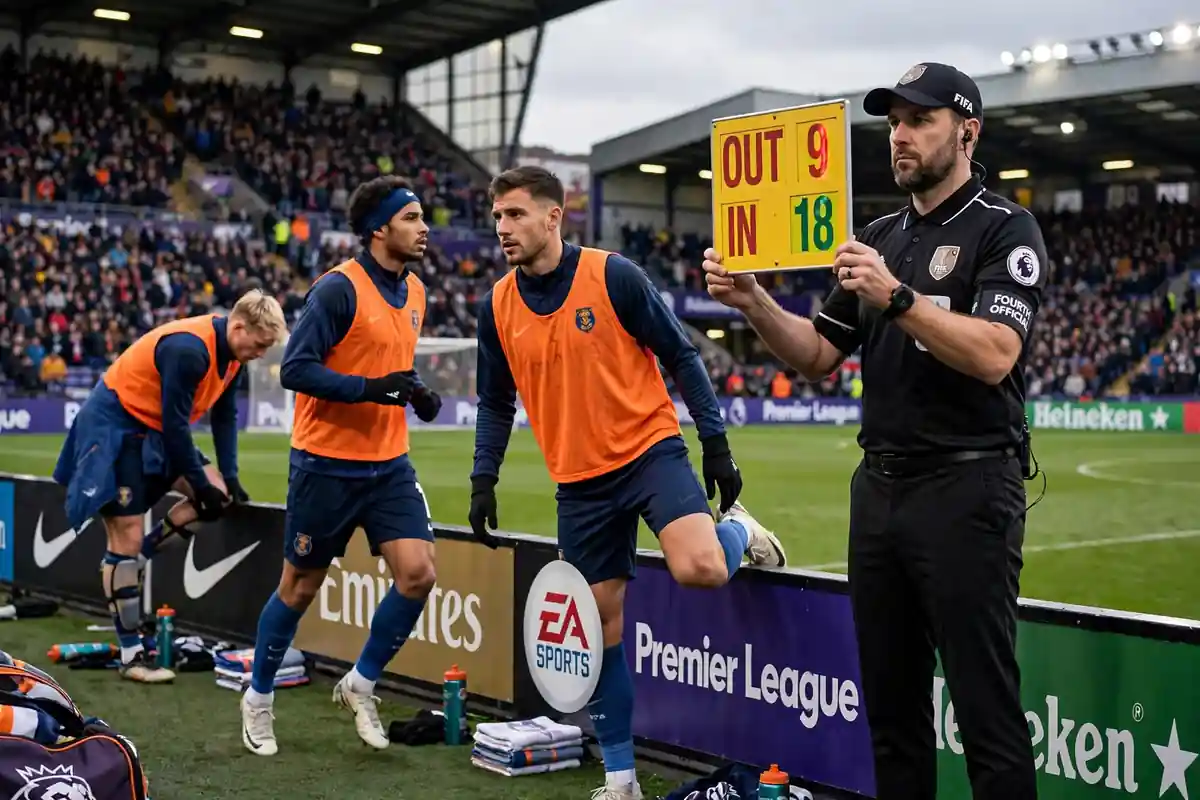
Under the current Laws (2025/26), each team may make up to 5 substitutions per match — but within no more than 3 substitution opportunities, plus half-time. This stops coaches from breaking up the game with five separate stoppages.
Also worth knowing: knockout matches that go to extra time allow a 6th substitute (with one extra opportunity), and competitions using concussion protocols grant an additional concussion substitute, so player safety never costs a team tactically. In the professional game a substituted player cannot return; youth and grassroots competitions may allow return substitutions.

How a Substitution Works
- The coach informs the fourth official who is coming off and on.
- The change takes place during a stoppage in play.
- The departing player leaves at the nearest boundary line.
- The replacement waits at the halfway line and enters only on the referee’s signal.
Matchday Squad Sizes Around the World
Each competition limits how many substitutes may be named on the bench:
| Competition | Starters | Named substitutes | Matchday squad |
|---|---|---|---|
| Premier League | 11 | 9 | 20 |
| La Liga | 11 | 12 | 23 |
| Bundesliga | 11 | 9 | 20 |
| FIFA World Cup (recent tournaments) | 11 | up to 15 | 26 |
So a “20-man squad” means everyone available that day — starters plus bench. Beyond that, clubs register even larger season rosters (25 senior players in the Premier League, for example).
The 7-Player Minimum Rule
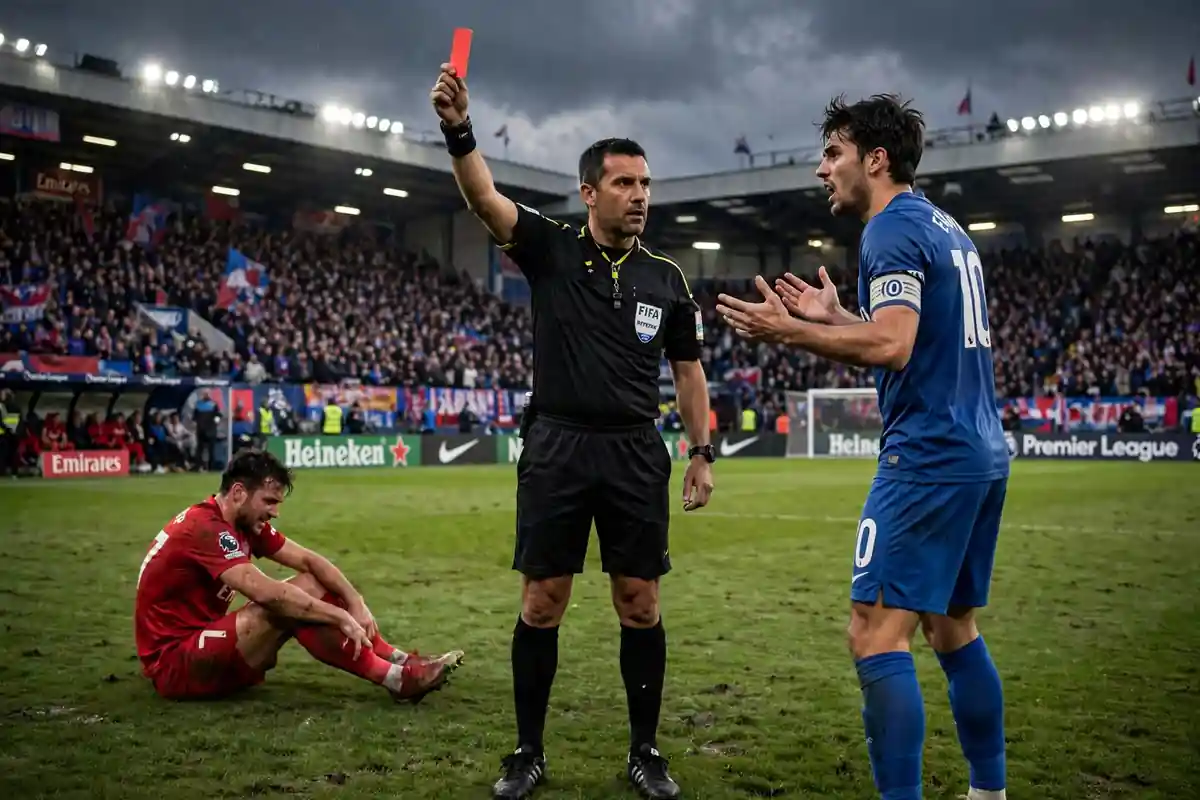
Red cards and injuries can shrink a team, but there is a hard floor: a match cannot start or continue if either team has fewer than 7 players. Drop to six — through dismissals, or injuries with no substitutes left — and the referee must abandon the match. The competition’s regulations then decide whether it is replayed or forfeited.
One nuance: if players deliberately walk off to drag their team below seven, the referee may play advantage and let the game flow — but the match cannot restart after the next stoppage until seven are back on the pitch.
Team vs Squad vs Lineup
- Starting lineup (the XI): the 11 players who begin the match.
- Matchday squad: everyone named for the game — starters plus bench (18–26, depending on the competition).
- Squad / roster: the full group registered for the season or tournament (often 25+).
So the layered answer is: 11 on the pitch, up to 26 in the matchday squad, 25-plus in the season roster.
Small-Sided Football: Fewer Players
- 5-a-side: 5 per team including the goalkeeper — see our 5-a-side football rules.
- 7-a-side: 7 per team, the classic youth and amateur format — see our 7-a-side football rules.
- Futsal: 5 per team on a hard court, with unlimited rolling substitutions.
- Beach soccer: 5 per team on sand.
Youth football scales the same way — 5v5 and 7v7 for the youngest, up to 9v9 and then full 11-a-side. New to the sport? Start with our football basics for beginners.
Why 11? A Short History
Eleven-a-side dates to the first written Laws of the Game, drawn up by England’s Football Association in 1863. Early matches sometimes featured dozens of players per side; the founders settled on 11 as the number that best balanced pitch size with pace and strategy. More than 160 years later, it has never changed.
Real Match Case Study
The Battle of Bramall Lane, 16 March 2002
The most famous example of the seven-player minimum in action happened in England’s First Division on 16 March 2002, when Sheffield United hosted West Bromwich Albion. The game became so chaotic that it earned the nickname “The Battle of Bramall Lane.”
Trouble started in the 9th minute when Sheffield United goalkeeper Simon Tracey was sent off for handling the ball outside the penalty area. Down to ten men, United fell behind to two West Brom goals. Then, in the 65th minute, two more United players were dismissed in quick succession after a brawl — Georges Santos for a dangerous tackle and Patrick Suffo for headbutting an opponent. That reduced the home side to eight players, and all their substitutes had already been used.
Late in the match, two United players — Michael Brown and Robert Ullathorne — were forced off through injury. With no substitutes left to bring on, Sheffield United were down to just six men on the pitch. Referee Eddie Wolstenholme had no choice: Law 3 states that a match cannot continue if either team has fewer than seven players, so he abandoned the game in the 82nd minute with West Brom leading 3–0. The Football League later awarded the match to West Brom.
The incident is a perfect illustration of why the rule exists — and of how thin a team can be stretched. Sendings-off, injuries, and an empty bench can combine to break the legal minimum, and when that happens, the game simply cannot go on.
Substitutes have not always been part of football, which makes this even more striking. At the 1970 FIFA World Cup in Mexico, substitutions were permitted at a World Cup for the first time — two per team. Before that era, an injured player often meant a team had to finish the match short-handed, making the seven-player minimum an even greater danger. The rules around player numbers and replacements exist to keep the game fair and safe, from the World Cup final down to a rainy afternoon in Sheffield.
Frequently Asked Questions
How many players are on the field during a football match?
22 in total — 11 per team, including one goalkeeper on each side. This is the standard for all full-size senior football worldwide.
Can a football match continue with fewer than 11 players?
Yes — a team can play on with 10, 9, or 8 players after sendings-off or injuries. The hard minimum is 7; below that, the referee must abandon the match.
How many substitutes are allowed in a football match?
Up to 5 per team, made within 3 stoppages of play (half-time excluded). Extra time allows a 6th substitute, and concussion protocols add one more on top.
What is the minimum number of players needed to start a match?
Seven per team. The same minimum applies throughout the game — a team that cannot field 7 players cannot continue.
Do women’s football teams also play 11-a-side?
Yes. The Laws apply equally to men’s and women’s senior football: 11 players, one goalkeeper, up to 5 substitutes, and the 7-player minimum. Only youth and small-sided formats use fewer players.
Conclusion: Key Takeaways
- 11 players per team (one must be the goalkeeper) — 22 on the pitch in total.
- 5 substitutes within 3 stoppages of play (plus half-time); a 6th is allowed in extra time.
- A minimum of 7 players per team is required to start or continue; fewer means the match is abandoned.
- Matchday squads run from 18 to 26 depending on the competition; season rosters are larger still.
- Small-sided formats — 5-a-side, 7-a-side, futsal, and beach soccer — use fewer players by design.
For more plain-language explainers, visit the GameGuidelines homepage — and if you would like to know who is behind the site, meet the team behind the site.
This article follows the IFAB Laws of the Game 2025/26. For the official wording of Law 3 (The Players), see IFAB’s official Laws of the Game.
