Football Corner Kick Rules: The Complete Guide to Law 17

A corner kick is awarded when the whole of the ball crosses the goal line — on the ground or in the air — after last touching a player of the defending team, and no goal is scored. The kick is taken from the corner arc nearest to where the ball went out, the ball must be stationary when kicked, opponents must stay at least 9.15 metres (10 yards) away, and a goal can be scored directly from the kick. There is no offside offence directly from a corner kick.
That is the short version. Below is the full breakdown of the corner kick procedure, the corner arc rules, the violations that get a kick retaken, and special situations like scoring directly from the corner flag.
When Is a Corner Kick Awarded?
Under IFAB Law 17, the referee awards a corner kick in these situations:
- The entire ball passes over the goal line (the line under the crossbar area, between the corner flag and the goalpost), having last touched a defending player, and no goal results.
- The referee penalises the goalkeeper for holding the ball in their hands or arms for more than eight seconds.
- The referee penalises a player for deliberately delaying the taking of a goal kick for their team.
The last two are recent additions to the Laws of the Game: if the goalkeeper holds the ball too long, the punishment is a corner kick to the attacking team — not a free kick.
The Corner Kick Procedure: Step by Step
The procedure is set out clearly in Law 17. Every corner kick must follow these steps:
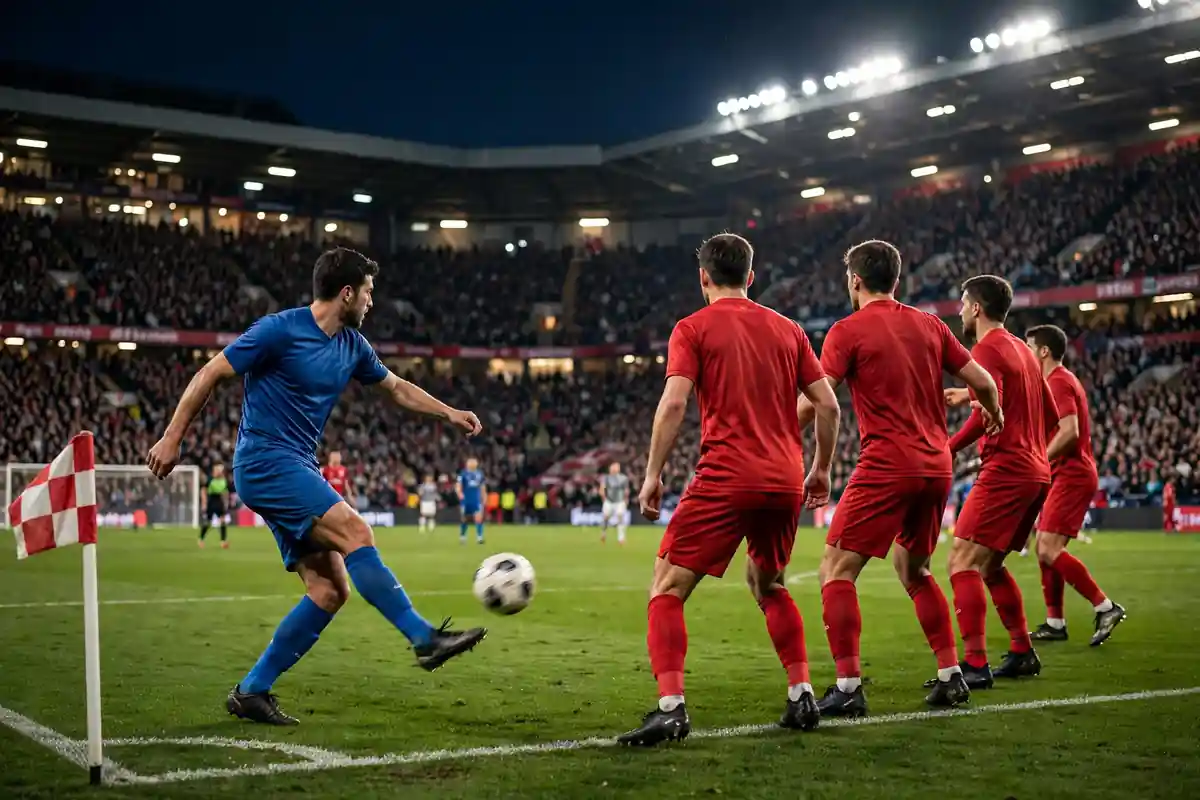
- Place the ball inside the corner area. The ball must be placed within the corner arc nearest to the point where the ball crossed the goal line (or nearest to the goalkeeper’s position, for the eight-second and time-wasting offences).
- The ball must be stationary. It cannot be rolling when it is kicked.
- An attacker takes the kick. Any player from the attacking team may take it — it does not have to be a specific player.
- The ball is in play once kicked and clearly moves. It does not need to leave the corner area to be in play.
- Do not move the corner flagpost. Lifting or shifting the flag to gain an advantage is an offence.
- Opponents stay 9.15 m away. Defending players must remain at least 9.15 metres (10 yards) from the corner arc until the ball is in play.
Corner Arc Rules: Where Exactly Does the Ball Go?
The corner arc — the quarter-circle marking in each corner of the pitch — has a radius of 1 metre (1 yard) from the corner flagpost. The key rule is simple: any part of the ball touching any part of the arc line counts as inside. The ball does not need to be fully inside the quarter circle; if it overhangs the line, it is legally placed.
One detail even experienced players get wrong: the corner must be taken from the corner nearest to where the ball crossed the goal line. Unlike a goal kick, which can be taken from either side of the goal area, you cannot walk the ball 70 yards to your preferred corner — this stops teams wasting time or switching sides just to get an inswinger instead of an outswinger. For a comparison with the other goal-line restart, see our guide to football goal kick rules.
Can You Score Directly From a Corner Kick?
Yes — and it has a name: the Olimpico (or Olympic goal). A goal may be scored directly from a corner kick, but only against the opposing team.
The famous exception works the other way: if the ball goes directly into the kicker’s own goal from the corner — without touching anyone else — no own goal is awarded. Instead, the referee awards a corner kick to the opponents. If the ball touches any other player first, normal rules apply and the goal stands.

Offside From a Corner Kick: The Exception Fans Forget
Here is one of the most useful rules in football: there is no offside offence if a player receives the ball directly from a corner kick. This is one of only three restarts with this exception — the others being the throw-in and the goal kick.
Why does this matter? An attacker can stand next to the goal line, level with or behind the last defender, when the corner is taken, and cannot be penalised for offside from that kick. Teams design entire routines around this: a player lurking at the far post is completely legal as long as they receive the ball directly from the corner.
The exception ends the moment anyone else touches the ball. If a teammate heads the corner on, offside is judged from that touch like any other phase of play.
Common Corner Kick Violations and Punishments
Referees see the same mistakes again and again at corner kicks. Here is what the law says about each:
- Kicker touches the ball twice. If the kicker plays the ball again before any other player has touched it, the referee awards an indirect free kick to the defending team. If the second touch is a handball, it becomes a direct free kick — or a penalty kick if it happens inside the kicker’s own penalty area (unless the kicker is the goalkeeper, in which case it is indirect).
- Ball placed outside the corner arc. If no part of the ball is inside the arc, the kick must be retaken. Referees increasingly watch for kickers nudging the ball outside the arc to get a better angle.
- Corner flagpost moved. The kick is retaken.
- Opponents too close. Defenders must be 9.15 m from the arc until the ball is in play. Encroachment means a retake.
- Kicking the ball at an opponent to replay it. If a player deliberately kicks the ball against an opponent (not carelessly or recklessly) just to play it again, the referee allows play to continue — this is legal.
- Holding and grabbing in the box. The pushing and shirt-pulling that happens during corners is a foul like anywhere else on the pitch, and persistent holding at a corner can result in a penalty kick.
- Any other offence. For anything not listed above, the corner kick is simply retaken.
Short Corners and Tactical Variations
Not every corner has to be swung into the penalty area. A short corner — playing the ball a few metres to a nearby teammate — is fully legal as long as the ball clearly moves. Teams use short corners to change the angle or draw defenders out.
The two classic deliveries are the inswinger (curving toward the goal) and the outswinger (curving away from it). Inswingers threaten the Olimpico and force the goalkeeper into difficult decisions; outswingers give attackers a running start at the ball.
Real Match Case Study: Two Corners That Made History
Few restarts have produced more iconic moments than the corner kick — and two stand above the rest.
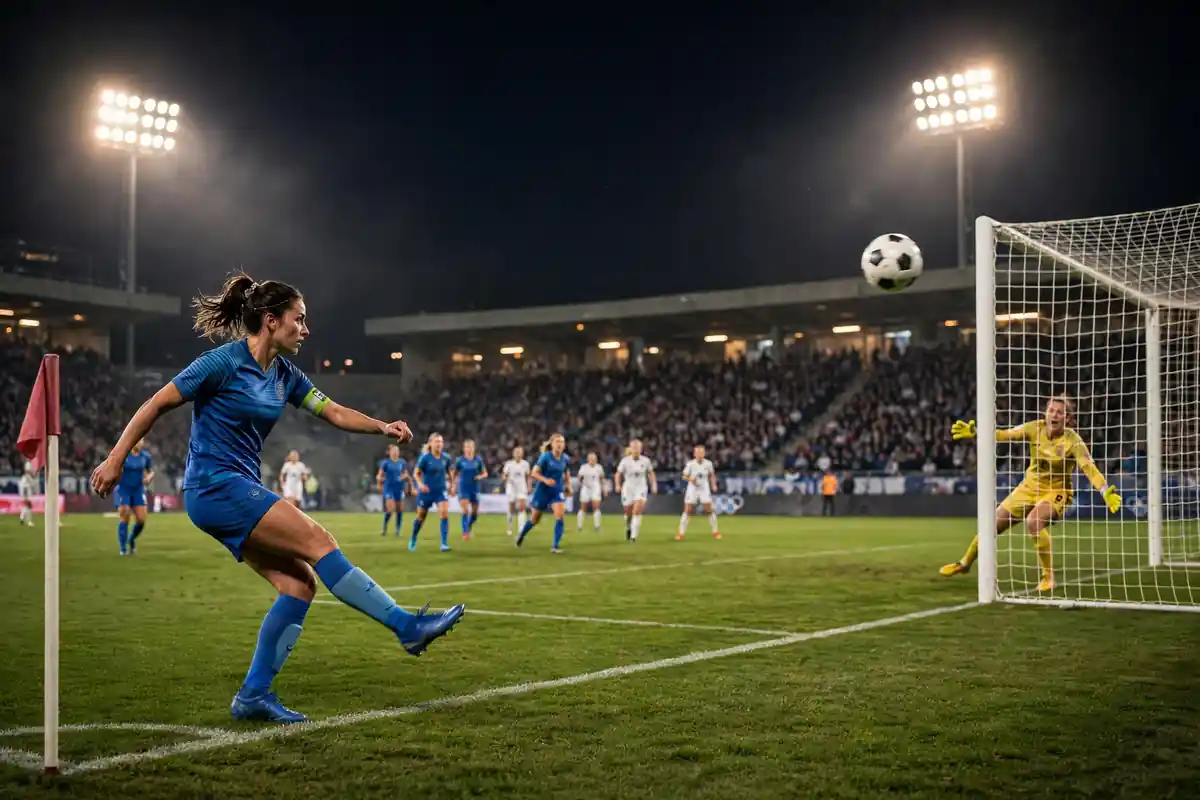
The first is the most famous “Olimpico” of the modern era. In the semifinal of the women’s football tournament at the London 2012 Olympics, the United States trailed Canada in a wild, rain-soaked match in Manchester. In the 78th minute, Megan Rapinoe stepped up to take a corner and curled the ball directly into the far corner of the net — no touch from anyone, straight in. The goal is a textbook illustration of Law 17: the ball was placed inside the corner arc, stationary, and once kicked and clearly moving it was in play. Because a goal may be scored directly from a corner against the opponents, the strike counted, and the Americans went on to win 4–3 after extra time before taking gold against Japan. It remains one of the rare Olimpicos scored on the biggest stage.
The second is the quickest-thinking corner in Champions League history. On 7 May 2019, Liverpool trailed Barcelona 3–0 from the first leg of their semifinal. In the 79th minute at Anfield, with Barcelona’s defenders still arguing with the referee and nowhere near set, Trent Alexander-Arnold spotted Divock Origi unmarked at the near post — and took the corner instantly instead of waiting. Origi swept it home for 4–0, completing one of the greatest comebacks ever played. The goal was perfectly legal: the ball was stationary inside the arc, and once kicked and clearly moving it was in play. Nothing in Law 17 requires the taker to wait for a whistle or for defenders to be ready; the 9.15-metre rule only says opponents must be that far away, and Barcelona simply were not organised. It is the ultimate proof that knowing the exact wording of a law can win you a European semifinal.
Frequently Asked Questions
Can a goalkeeper pick up the ball from a corner kick?
Yes. Once the ball is in play, the goalkeeper may catch it like any other ball in open play. There is no special protection — if the goalkeeper fumbles it, attackers can score.
Does the ball have to leave the corner arc to be in play?
No. Since a law change, the ball is in play as soon as it is kicked and clearly moves. It does not need to leave the corner area. This is what makes short corners possible.
Can the same player take the corner and then score?
Only after someone else touches the ball. If the kicker’s corner hits the goal frame and bounces straight back to them, playing it again is a double-touch offence — indirect free kick to the defenders.
What happens if the corner kick goes out of play without touching anyone?
It depends where it crosses the line: over the goal line means a goal kick to the defenders; over the touchline means a throw-in to the defenders.
Is there a time limit for taking a corner kick?
The laws set no fixed number of seconds, but referees can punish clear time-wasting with a yellow card for delaying the restart of play.
Conclusion
The corner kick is a simple restart with outsized importance — a large share of goals at every level come from corners. Remember the essentials of Law 17: ball inside the nearest corner arc, stationary when kicked, opponents 9.15 metres away, no offside directly from the kick, and a goal counts if scored directly against the opponents.
For the official wording, read Law 17 – The Corner Kick on the IFAB website. And to keep learning, explore the rest of our guides here at GameGuidelines — including our about us page to see who is behind these explanations.
