Direct vs Indirect Free Kick: What’s the Difference?
The difference between a direct and an indirect free kick comes down to one simple rule: from a direct free kick you can score straight away, while from an indirect free kick the ball must touch another player before a goal can count. Everything else — the referee’s signals, the list of offences — flows from this one rule.
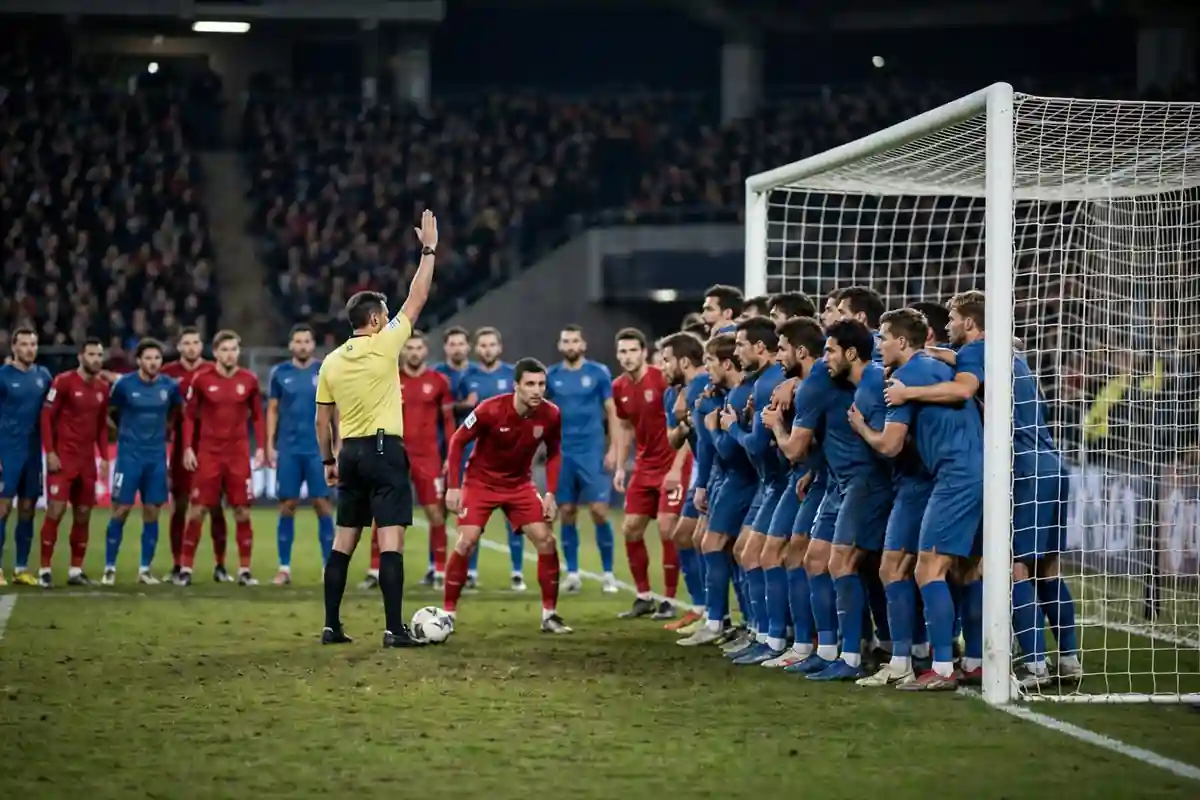
Watch any match closely and you will notice that after some whistles the referee raises one arm straight into the air. That raised arm is the universal indirect free kick signal — everyone on the pitch instantly knows a goal cannot be scored directly. No raised arm? Then it is a direct free kick, and the taker is free to shoot on sight.
Both types are covered by Law 13 of the IFAB Laws of the Game. Here is what each kick means, which fouls earn each type, how to read the referee’s signal, and what happens in tricky situations like free kicks inside the penalty area.

What Is a Direct Free Kick? (Direct Free Kick Meaning)
A direct free kick is a free kick from which a goal can be scored directly — the ball does not need to touch anyone else. This is the classic set piece: a specialist 20–25 yards out, a defensive wall, and a curling shot into the top corner.
Direct free kicks are awarded for the more serious offences — fouls involving careless, reckless, or excessively forceful contact, plus handball. Under Law 12, the referee awards a direct free kick when a player:
- Kicks, trips, strikes, or jumps at an opponent (or attempts to)
- Charges or pushes an opponent
- Tackles or challenges an opponent
- Holds an opponent
- Spits at an opponent
- Handles the ball deliberately (handball) — except the goalkeeper inside their own penalty area
One exception: a direct free kick cannot be awarded inside the offending team’s own penalty area — the restart becomes a penalty kick instead. New to the game? See our football rules for beginners guide.
What Is an Indirect Free Kick?
An indirect free kick is a free kick from which a goal cannot be scored unless the ball touches another player first — from either team. The taker must pass before anyone shoots.
Which fouls are indirect?
Indirect free kicks are given for less serious, mostly technical offences rather than violent fouls:
- Playing in a dangerous manner — for example, raising a boot high near an opponent’s head. With no contact, it is dangerous play (indirect), not a direct free kick offence.
- Impeding an opponent without contact — blocking a run without touching the player or the ball.
- Preventing the goalkeeper from releasing the ball from their hands.
- Goalkeeper handling offences — handling a deliberate back-pass from a teammate, handling directly from a teammate’s throw-in, or picking the ball up again after releasing it before anyone else has touched it.
- Offside — every offside offence restarts with an indirect free kick.
- Misconduct stoppages — when play is stopped to caution or send off a player for dissent or other misconduct.
One recent change: holding the ball too long used to be an indirect free kick. Under the current IFAB Laws (2025/26), a goalkeeper who holds the ball for more than eight seconds concedes a corner kick instead.
The Referee Arm Signal: How to Tell Them Apart
To tell which kick was awarded, watch the referee:
- Indirect free kick signal: the referee raises one arm vertically and keeps it raised until the kick is taken and the ball has touched another player or gone out of play. That raised arm tells everyone a direct shot is not allowed.
- Direct free kick: no special signal — the referee simply points in the direction of attack. The absence of the raised arm means a direct shot is legal.
Remember: see the arm go up, and the first touch must be a pass.

Direct vs Indirect Free Kick: Side-by-Side Comparison
| Direct Free Kick | Indirect Free Kick | |
|---|---|---|
| Can you score directly? | Yes — a goal can be scored straight from the kick | No — the ball must touch another player first |
| Referee’s signal | Arm points in the direction of attack (no raised arm) | One arm raised vertically, held until the ball is touched or out of play |
| Awarded for | Serious fouls: kicking, tripping, pushing, holding, handball | Technical offences: dangerous play, impeding without contact, goalkeeper handling offences, offside |
| Inside the penalty area | Becomes a penalty kick instead | Can still be awarded as an indirect free kick inside the box |
| Kicked directly into the opponents’ goal | Goal stands | No goal — a goal kick is awarded to the defending team |
| Kicked directly into your own goal | No goal — a corner kick is awarded to the opponents | No goal — a corner kick is awarded to the opponents |
| Defensive wall distance | 9.15 m (10 yards) | 9.15 m (10 yards) |
| Typical tactic | One specialist shoots at goal | A rehearsed routine: lay-off, dummy run, or short pass then shot |
Special Situations You Should Know
Indirect free kicks inside the penalty area
This is where matches get chaotic. Serious fouls in the box become penalties, but technical offences can still produce an indirect free kick inside the penalty area — the classic case is a goalkeeper picking up a deliberate back-pass. Defenders pack the goal line, the ball is laid off, and someone smashes it through the crowd.
What if the ball goes straight in?
- Indirect kick, straight into the opponents’ goal, no touch: no goal — a goal kick to the defending team.
- Indirect or direct kick, straight into your own goal: a corner kick to the opposition. This surprises many fans — Law 13 says a goal cannot be scored directly into your own net from any free kick, so it is never an own goal. (See our football corner kick rules guide.)
Rules that apply to both types
The ball must be stationary when the kick is taken, all opponents must be at least 9.15 metres (10 yards) away, and the kicker may not touch the ball again until another player has touched it — otherwise the opponents get an indirect free kick. If three or more defenders form a wall, attackers must stay at least 1 metre away from it.
Tactics: How Teams Treat Each Kick Differently
A direct free kick is a duel between one specialist and the goalkeeper: the wall blocks the shot, and the kicker tries to curl, dip, or power the ball into the exposed corner.
An indirect free kick is a team puzzle. Because a second touch is mandatory, teams rehearse routines — the lay-off (tap sideways, strike first-time), the dummy run (sprint over the ball to fool the wall), or a quick chip for a teammate to finish. Defenders, knowing a pass must come, charge down the first touch instead of just blocking a shot.
Real Match Case Study: The Impossible Strike and the Punished Time-Waster
On 3 June 1997, in a friendly tournament in France, Brazil’s Roberto Carlos produced the most famous direct free kick ever scored. From roughly 35 yards against the host nation, he struck the ball with the outside of his left boot; it started yards wide of the goal, bent impossibly around the wall, clipped the inside of the post and went in. French goalkeeper Fabien Barthez never moved. The goal is the purest possible illustration of a direct free kick: awarded for a foul, no second touch required, and a goal counts straight from the kick. Physicists have spent years modelling the swerve — but for our purposes, it is simply Law 13 at its most spectacular.

The most televised indirect free kick inside a penalty area came in far less glamorous circumstances. In September 2015, Liverpool goalkeeper Simon Mignolet collected the ball against Bordeaux in the Europa League — and held it. And held it. Under the laws then in force, a goalkeeper controlling the ball with the hands for more than six seconds committed an offence, and the referee finally lost patience after roughly twenty seconds, awarding Bordeaux an indirect free kick inside Liverpool’s box. Defenders lined up on the goal line, the ball was touched sideways, and Bordeaux scored. The referee’s arm stayed raised throughout — the universal signal that a goal could not come directly. Note how the law has evolved since: under the 2025/26 Laws, holding the ball too long (now eight seconds) is punished with a corner kick, not an indirect free kick — but the Mignolet incident remains the classic classroom example of why the raised-arm signal matters and how chaotic an indirect free kick a few yards from goal can be.
Frequently Asked Questions
How can you tell if a free kick is direct or indirect?
Watch the referee’s arm. One arm raised straight above the head — and held there — means an indirect free kick. No raised arm, just a pointing arm, means a direct free kick and the taker may shoot directly.
Which fouls result in an indirect free kick?
Technical rather than violent offences: dangerous play, impeding without contact, stopping the goalkeeper releasing the ball, goalkeeper handling offences (back-pass, throw-in handling, re-handling after release), every offside offence, and misconduct stoppages such as dissent.
What happens if an indirect free kick goes straight into the goal?
The goal does not count. Straight into the opponents’ goal with no other touch: goal kick to the defending team. Straight into the kicker’s own goal: corner kick to the opposition.
Can a goalkeeper score from a direct free kick?
Yes. Nothing in the laws stops a goalkeeper taking a direct free kick and scoring directly into the opponents’ goal — legal, just extremely rare.
Why is offside punished with an indirect free kick?
Offside is a positional, technical infringement with no foul contact or dangerous play. The laws treat it as a lesser offence, so the restart is an indirect free kick from where the player became involved in active play.
Conclusion
The direct vs indirect free kick distinction is simpler than it looks: direct means you can shoot; indirect means someone else must touch the ball first. Spot the referee’s raised arm and you will instantly know what is coming.
For the full picture, explore our football rules guides — GameGuidelines explains every IFAB law in plain language. You can also learn more about our team. For the official wording, see the IFAB Laws of the Game.
