Football Scoring Goal Rules: IFAB Law 10 Fully Explained
Football’s entire purpose fits in one sentence of Law 10 of the IFAB Laws of the Game — Determining the Outcome of a Match: a goal is scored when the whole of the ball passes over the goal line, between the goalposts and under the crossbar, provided no offence has been committed. Everything else in this law answers the questions that follow — what if the scores are level, what if extra time cannot separate the teams, and how do we decide a winner fairly?
This guide covers when a goal counts, goal-line technology, disallowed goals, drawn matches, extra time, the abolished away-goals rule, and the penalty shootout. For more guides like this, visit the GameGuidelines homepage — we are building the web’s friendliest football rules library.
When Does a Goal Count?
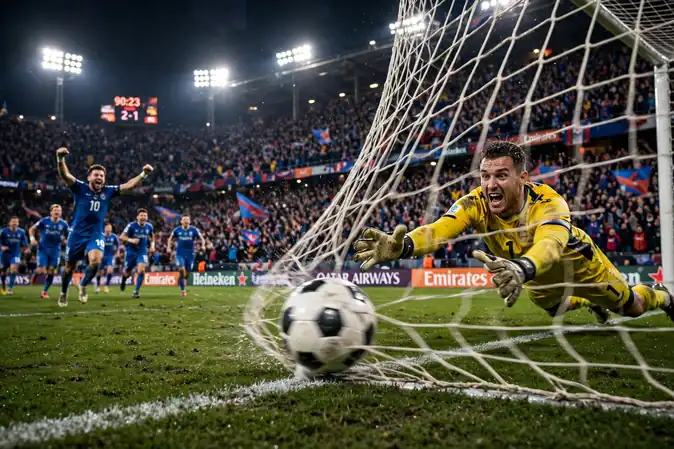
Three conditions must all be met for a goal to be awarded:
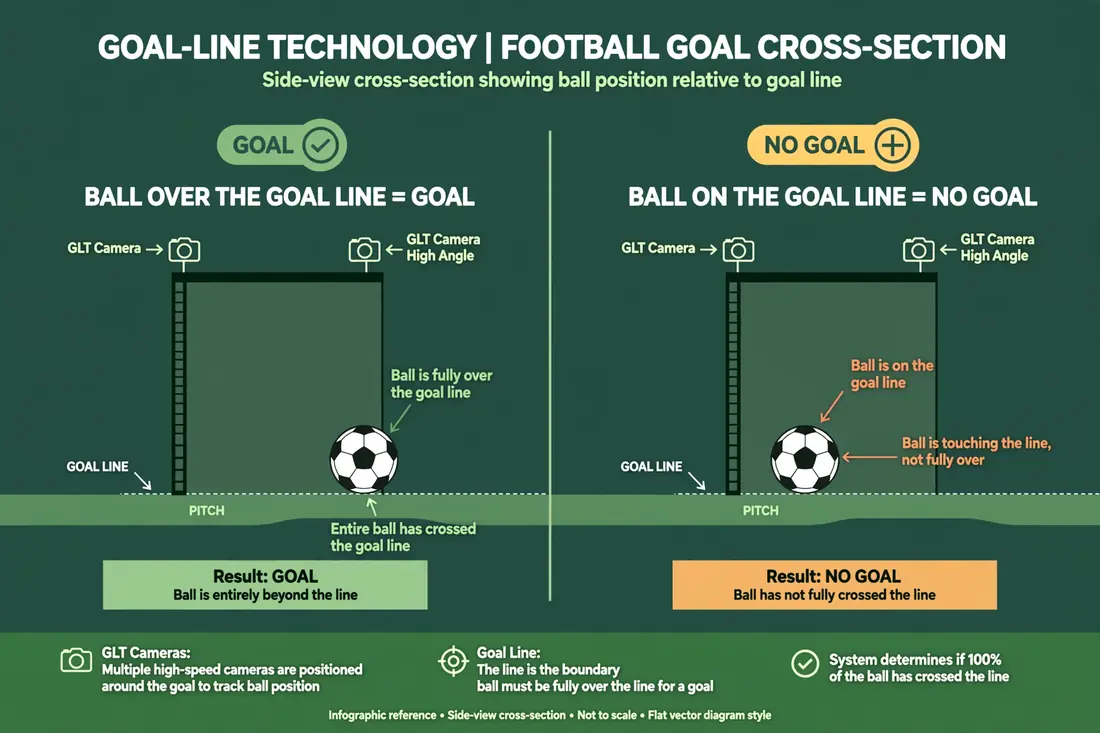
- The whole ball crosses the goal line — the same “wholly over” principle as the ball-in-play law. A ball 99% over the line is not a goal.
- Between the goalposts and under the crossbar — a ball that crosses the line outside the posts is simply out of play.
- No offence by the scoring team in the immediate build-up — no offside, no foul, no handball offence.
If all three hold, the referee awards the goal. If any fails, play restarts accordingly (usually with a free kick to the defending team or with play continuing). Note the order of judgment: the referee first checks for offences, then whether the ball crossed. A goal “scored” after the ball went out of play, or from an offside position, was never a goal at all.
One curiosity added in 2019: a goalkeeper cannot score by throwing the ball directly into the opponents’ goal. If it happens, the goal is disallowed and a goal kick is awarded to the defending team. The law treats a thrown ball differently from a kicked one — only a kick (or a deflection off another player) can legally produce a goal from the goalkeeper’s hands.
Goal-Line Technology: How It Works
For most of football’s history, the hardest judgment in the sport relied on two pairs of human eyes. That ended after the 2010 World Cup, when IFAB approved goal-line technology (GLT) in July 2012. The systems in use — Hawk-Eye (Premier League) and GoalControl (2014 World Cup) — work the same way:
- Multiple high-speed cameras around the stadium track the ball in three dimensions, many times per second.
- Software calculates the ball’s exact position relative to the goal line.
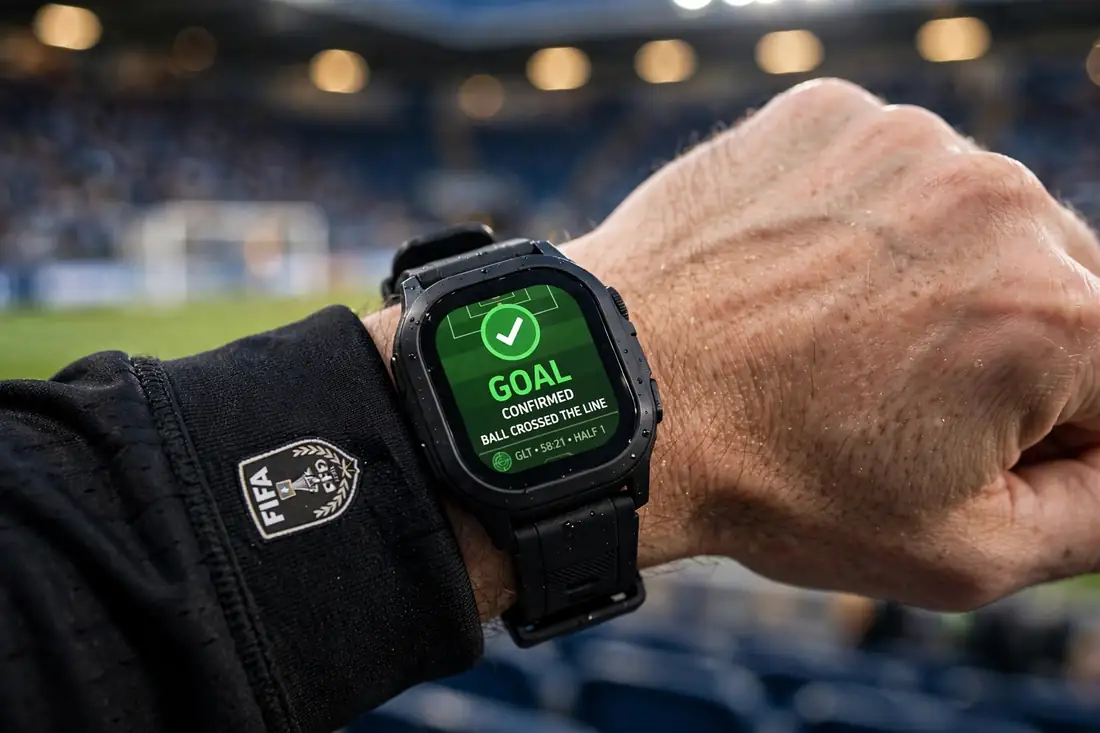
- The instant the whole ball crosses, an encrypted signal reaches the referee’s watch within one second, displaying “GOAL”.
The referee remains the decision-maker — the watch is an aid, not an autopilot — but in practice the signal is definitive. GLT answers only one question (did it cross?), unlike VAR, which reviews offences. The two systems complement each other: GLT settles the line, VAR settles everything before it.
Disallowed Goals: Why Good Strikes Get Chalked Off
A ball crossing the line is not enough if the scoring team broke a law first. The common reasons:
- Offside in the build-up — the most frequent cause, now judged to the centimetre with semi-automated offside technology.
- Foul by the scorer or a teammate — pushing a defender, for example.
- Handball offence — including accidental handball by the scorer immediately before the goal.
- Ball out of play earlier in the move — VAR can rewind the attack and find the ball wholly over a touchline seconds earlier.
- Offence at the restart — such as encroachment the referee deems material, or a double touch at a penalty.
When a goal is disallowed, the restart depends on the offence: usually a free kick to the defending team from where the offence occurred.
Drawn Matches: What Happens Next?
The team scoring the greater number of goals wins. If both score the same number — or neither scores — the match is drawn. In league football, that is the end of it: one point each. But knockout competitions need a winner, and competition rules (not Law 10 itself) decide the method. Law 10 permits three tiebreakers, used in this order where applicable:
1. Extra Time
Two further periods of 15 minutes each, played in full — there is no golden goal in the modern game (more on that below). If the scores remain level, the tie goes to the next method. Our guide to football extra time rules covers the details, including the short break between normal time and extra time.
2. The Away-Goals Rule (Abolished)
For decades, two-legged ties in UEFA competitions were decided by away goals: if the aggregate score was level, the team that scored more goals away from home advanced. The rule was designed to encourage attacking away performances and reduce extra time. UEFA abolished it from the 2021–22 season (announced 24 June 2021), arguing it had outlived its purpose — modern travel, pitch quality, and tactics had erased the old home advantage, and teams were playing too cautiously at home. Ties level on aggregate now go straight to extra time and then penalties. For the full history, see our article on the football away goals rule.
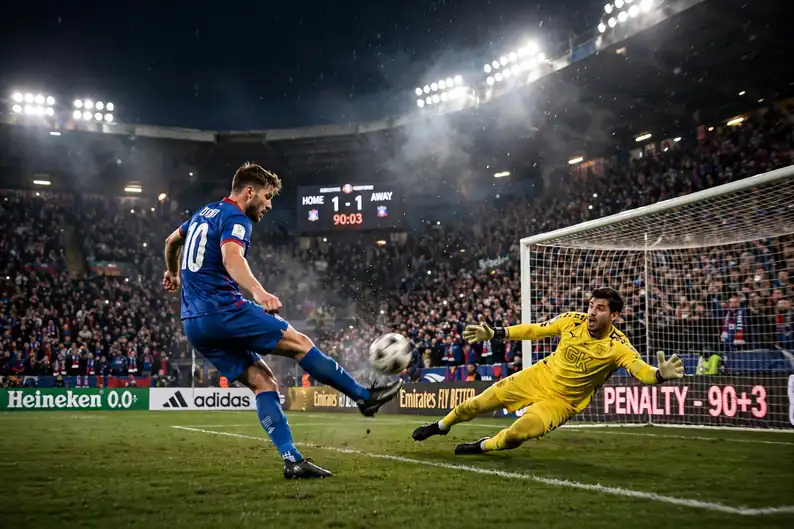
3. Kicks from the Penalty Mark (The Shootout)
If the tie is still level, it is decided by a penalty shootout. The procedure:
- Each team takes five kicks alternately; the team scoring more wins.
- If still level after five each, it goes to sudden death — one kick each until one scores and the other misses.
- Only players on the field at the final whistle may take part (plus goalkeepers, with limited injury replacements).
- The kicks do not count toward the match score or players’ goal tallies — the official result is recorded as a draw.
- The referee tosses a coin for which goal to use and which team kicks first.
Shootouts are the cruellest and most theatrical tiebreaker in sport. Our complete guide to penalty shootout rules walks through the full procedure, including goalkeeper conduct and the sudden-death order.
The Golden Goal: A Dead Experiment
Between 1993 and 2004, FIFA tried to avoid shootouts with the golden goal: the first team to score in extra time won instantly. It was used at the 1998 and 2002 World Cups — France won Euro 2000 with a golden goal — but it backfired. Teams, terrified of conceding, played even more defensively in extra time, producing fewer goals, not more. FIFA replaced it briefly with the silver goal (leading at half-time of extra time wins), then scrapped both in 2004. Extra time is now always played to its full 30 minutes. The full story is in our article on the football golden goal rule.
How Winners Are Decided: Comparison
| Method | When used | Key feature |
|---|---|---|
| Full time result | All matches | Most goals wins; level scores = draw |
| Extra time | Knockout ties (if competition rules say so) | 2 × 15 minutes, always played in full |
| Away goals | Abolished by UEFA from 2021–22 | Previously decided level two-legged ties |
| Penalty shootout | Knockout ties still level | 5 kicks each, then sudden death; recorded as a draw |
| Golden goal | Abolished 2004 | Former sudden-death extra-time winner |
What If? Tricky Scoring Scenarios
What if the ball crosses the line but the referee had already blown for a foul? No goal. Play stopped at the whistle; everything after it is dead. This is why referees are taught to delay the whistle when an advantage might develop.
What if a shot crosses the line a split-second after the full-time whistle? No goal — the match ended at the whistle. The only exception is a penalty kick awarded before time expires, which must be completed.
What if the ball goes in off the referee? Since the 2019 law change, if a deflection off a match official leads directly to a goal, play is stopped and restarted with a dropped ball. The goal cannot stand.
What if a goalkeeper throws the ball into the opponent’s net? No goal — a goal kick is awarded to the defending team. A goalkeeper can only score with a kick (or if the ball deflects off another player).
What if both teams’ fifth penalties are missed and it’s still level? Sudden death continues, one kick each, in the same order, until one round produces a winner. There is no limit.
What if a shootout kicker is injured mid-shootout? An injured goalkeeper may be replaced (with restrictions); an injured outfield kicker cannot be replaced by someone who finished the match off the field — the team simply continues with one fewer eligible kicker.
What if the scores are level but the competition needs a winner and bans shootouts? Some youth and amateur competitions use alternatives the organisers define, but under IFAB-sanctioned senior football, extra time then penalties is the standard path.
What if a goal is scored directly from a goalkeeper’s goal kick bouncing over the opposing keeper? It counts — a goal may be scored directly from a goal kick (unlike the throw-in rule for the keeper’s hands). It is rare, but legal.
Real-Match Case Studies
The goal that changed football — England vs Germany, 27 June 2010. In the World Cup round of 16 in Bloemfontein, England trailed Germany 2–1 when Frank Lampard’s exquisite chip beat Manuel Neuer, struck the underside of the crossbar, and bounced a full yard over the goal line before spinning back out. Uruguayan referee Jorge Larrionda waved play on. England lost 4–1, but the injustice became the most consequential non-goal in history: FIFA president Sepp Blatter publicly apologised, and within two years IFAB approved goal-line technology, first used at the 2014 World Cup. Lampard later said he was pleased his disallowed strike “changed the game for the better.” Law 10’s first sentence — the whole ball over the line — finally had technological eyes.
The first technology goal — France vs Honduras, 15 June 2014. At the Estádio Beira-Rio in Porto Alegre, during France’s World Cup Group E opener, Karim Benzema’s 48th-minute shot came back off the post and Honduras goalkeeper Noel Valladares fumbled the rebound over his own line before scooping it away. Brazilian referee Sandro Ricci consulted the GoalControl system, which confirmed the whole ball had crossed, and awarded the goal — officially an own goal by Valladares — despite Honduran protests. France won 3–0. It was the first goal in World Cup history decided by goal-line technology, the moment Law 10’s hardest judgment moved from human eyes to cameras.
The final that penalties decided — Brazil vs Italy, 17 July 1994. After 120 goalless minutes in brutal midday heat at the Rose Bowl in Pasadena, the World Cup final went to a penalty shootout — the first ever to decide football’s biggest match. Italy’s Franco Baresi skied the first kick; Brazil’s Márcio Santos had his saved; then Roberto Baggio, the tournament’s star, blazed Italy’s decisive fifth penalty over the bar, and Brazil won 3–2 to lift their fourth title. The image of Baggio standing hands-on-hips, head bowed, remains the defining picture of shootout heartbreak — and the ultimate proof of why Law 10 needs its tiebreakers: sometimes 120 minutes simply cannot separate two teams.
Frequently Asked Questions
What counts as a goal in football?
A goal is scored when the whole of the ball passes over the goal line, between the goalposts and under the crossbar — provided the scoring team committed no offence (offside, foul, handball) in the build-up.
How does goal-line technology work?
Camera systems (Hawk-Eye or GoalControl) track the ball and send a signal to the referee’s watch within one second when the whole ball crosses the line. It was approved by IFAB in 2012 and first used at the 2014 World Cup.
What happens if a match ends in a draw in a knockout competition?
Competition rules decide: usually two 15-minute periods of extra time, then a penalty shootout (five kicks each, then sudden death). The shootout result is recorded as a draw in official records.
Is the away-goals rule still used?
No. UEFA abolished the away-goals rule from the 2021–22 season. Level two-legged ties now go to extra time and then penalties.
Can a goalkeeper score by throwing the ball into the other goal?
No. Since 2019, if a goalkeeper throws the ball directly into the opponents’ goal, the goal is disallowed and a goal kick is awarded. A goalkeeper can only score with a kick.
Do penalty shootout goals count in a player’s record?
No. Kicks from the penalty mark do not count toward the match score or individual goal tallies; the match is officially recorded as a draw.
What was the golden goal?
A 1993–2004 experiment where the first goal in extra time won the match instantly. It made teams more defensive, not less, so FIFA scrapped it (and its successor, the silver goal) in 2004.
Sources
- IFAB Laws of the Game — Law 10: Determining the Outcome of a Match
- IFAB Laws of the Game — full document library
- Premier League — Law changes for 2019/20 explained
